


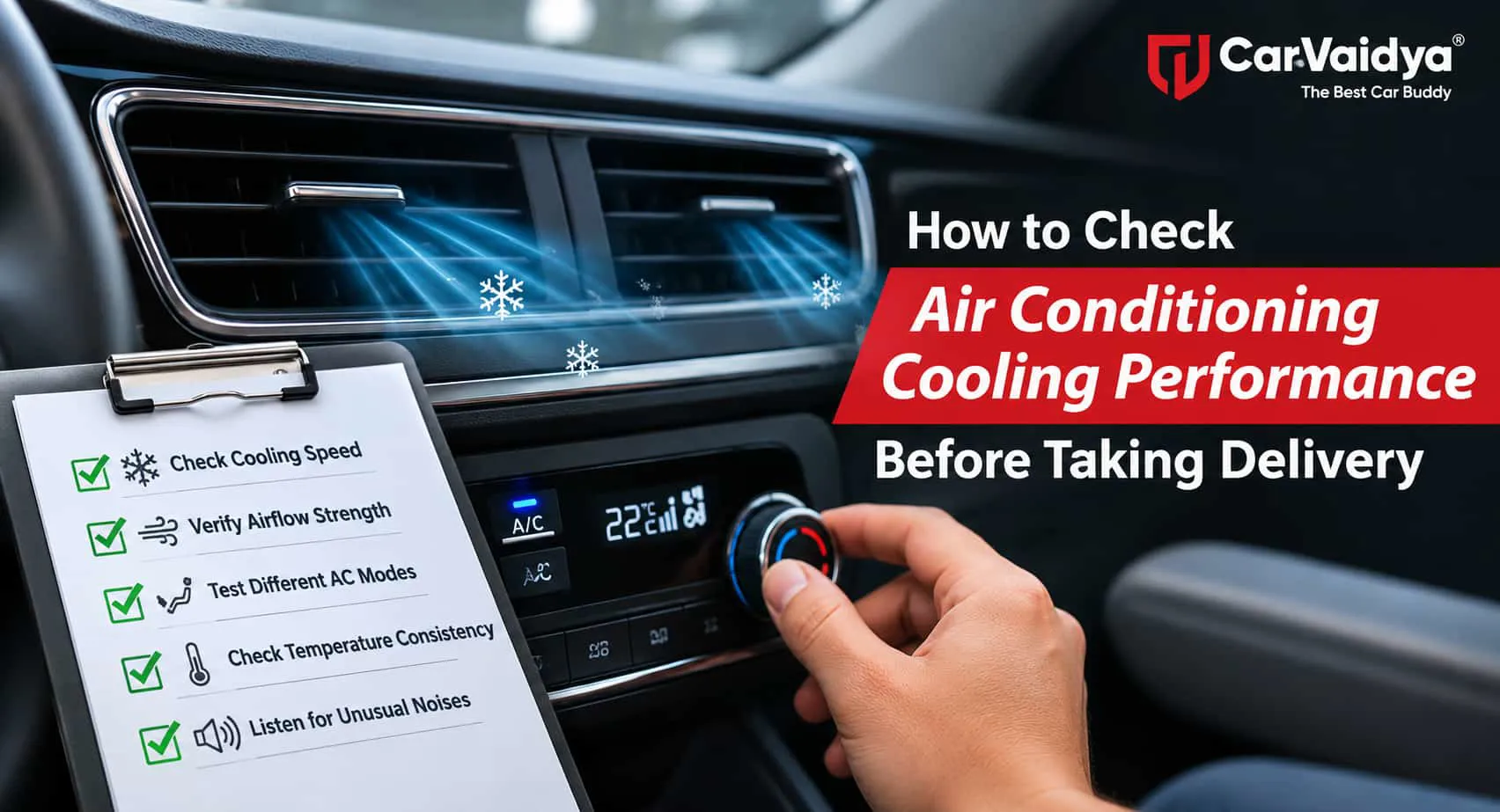
How to Check Air Conditioning Cooling Performance Before Taking Delivery
 By CarVaidya
- 10 Nov 2026
In most parts of India, the AC is one of the most-used features in a car. Yet on delivery day, it usually gets a quick test: someone switches it on in the showroom, feels the cool air, and moves on. That's not enough to tell whether the system is working properly.
A new car's AC can have issues from the factory, from a low refrigerant fill, or from damage during transport. These are much easier to fix before you sign the delivery papers than after. This guide shows you how to check AC cooling performance step by step, what's normal, and the warning signs to watch for.
Quick Answer
To check a new car's AC before delivery, start the engine, set the AC to its coldest setting with recirculation on, and let it run for 10 to 15 minutes, ideally with the car parked outside. The air from the centre vents should become clearly cold within a few minutes and stay cold. Check all vents and fan speeds, listen for unusual noises, watch for bad smells, and confirm a little water drips under the car after running. Test the AC again during the test drive and at idle. If cooling is weak or inconsistent, report it before accepting delivery.
Why You Should Test the AC Before Delivery
- Problems are cheaper to fix now. Before you accept the car, the dealer is responsible for correcting defects. Afterwards, you'll be booking service visits and waiting for warranty approvals.
- Showroom tests can be misleading. A car that's been parked indoors will feel cool quickly. The real test is in heat, after the car has been sitting in the sun.
- Small issues can grow. A slow refrigerant leak or a weak compressor may cool fine on day one and fail a few weeks into summer.
- Comfort matters every day. In Indian summers and city traffic, a weak AC makes every drive uncomfortable.
What You'll Need
- 15 to 20 minutes with the car
- Ideally, a spot outdoors or in daylight rather than an air-conditioned showroom
- A digital thermometer with a probe, or an infrared thermometer (optional but useful)
- Your phone, to note readings and record any noises
How to Check AC Cooling: Step by Step
Step 1: Start with a warm cabin
If possible, ask for the car to be parked outside for a while before you test it. A cabin that's already warm gives a much more honest result than one that's been sitting in an air-conditioned showroom.
Step 2: Set the AC correctly
- Start the engine. In a hybrid or EV, switch the car to ready mode.
- Turn the AC on and set the temperature to the lowest setting.
- Set the fan to a medium-high speed.
- Select recirculation mode and direct the air to the face vents.
- Close all doors and windows.
For automatic climate control, set it to the lowest temperature first. You can test the AUTO mode separately later.
Step 3: Measure how quickly it cools
Within the first couple of minutes, the air from the centre vents should feel noticeably cold. Within about 10 minutes, the cabin should feel comfortably cool, depending on outside temperature.
If you have a thermometer, place it a little inside a centre vent. A healthy system usually brings the vent air well below the outside temperature, often into the single digits or low teens in °C once it settles. Exact figures vary with the model, outside heat, humidity, and fan speed, so use it to compare vents and look for weak or rising readings rather than chasing a precise number.
Step 4: Check every vent
- Compare the left, centre and right vents. They should all blow similar cold air.
- Check the rear AC vents if your car has them.
- Switch between face, feet, face-and-feet and windscreen modes. Air should move to the right place each time.
- Check that the vent flaps open, close, and turn smoothly.
Step 5: Test all fan speeds and controls
- Go through every fan speed. Airflow should increase steadily with each step.
- Test temperature changes from coldest to warmest. The air should respond.
- For dual-zone systems, set different temperatures on each side and confirm both work.
- Test AUTO mode, the fresh-air and recirculation switch, and the demister.
- If the car has ventilated seats, check them too.
Step 6: Listen for unusual noises
When the AC switches on, you'll normally hear a soft click as the compressor engages and a slight change in engine idle. That's normal. Pay attention to grinding, rattling, squealing, or loud clicking from the engine bay or behind the dashboard. These can point to compressor, belt, or blower problems.
Step 7: Check for smells
A brand-new car may have a mild "new car" smell from the interior materials. A musty, damp, or burning smell from the vents isn't normal and should be checked.
Step 8: Test at idle and while driving
During the test drive, notice whether cooling stays strong while moving and at a standstill. Some weak systems cool well at speed but struggle at idle, which is exactly when you'll need them most in traffic.
Step 9: Look for water under the car
After running the AC for a while, a small puddle of clear water under the car, usually near the front passenger side, is normal. It's condensation draining out. No water at all after a long run in humid weather can mean a blocked drain, which may later cause water to drip inside the cabin.
Step 10: Watch the engine temperature
With the AC running, the engine temperature gauge should stay at its normal level. The radiator fan should switch on as needed. Rising temperature with the AC on is a warning sign.
Normal vs. Warning Signs
| What you notice | Normal or concern? | Possible cause |
|---|---|---|
| Soft click when AC turns on | Normal | Compressor engaging |
| Clear water dripping under the car | Normal | Condensation draining |
| Air only mildly cool after several minutes | Concern | Low refrigerant, leak, or compressor issue |
| Cold air that turns warm after a while | Concern | Compressor cycling problem, sensor, or freezing evaporator |
| One vent colder than the others | Concern | Blend door or duct issue |
| Weak airflow even at high fan speed | Concern | Blower motor, blocked cabin filter, or obstruction |
| Grinding, rattling or squealing | Concern | Compressor, belt, or blower fan |
| Musty or burning smell | Concern | Moisture, debris, or electrical fault |
| Water inside the footwell | Concern | Blocked or disconnected drain pipe |
| Engine temperature rises with AC on | Concern | Radiator fan or cooling system issue |
Things to Check Under the Bonnet
You don't need to be a mechanic for a quick look:
- AC pipes and joints: Look for oily residue around the aluminium pipes and their connections. Refrigerant leaks often leave an oily film.
- Condenser: The radiator-like grille behind the front bumper should be clean and undamaged, with no bent fins.
- Radiator fan: It should run when the AC is on and the engine warms up.
- Drive belt: On engine-driven compressors, the belt should look new with no cracks or fraying.
A Note on Electric and Hybrid Cars
In EVs and many hybrids, the AC compressor is electric and runs off the high-voltage battery, not the engine. The test is the same: check cooling speed, vent temperature, airflow, and noise. You may hear a soft electric hum from the compressor, which is normal. Also check that pre-cooling through the car's app, if available, works as described.
What to Do If the AC Isn't Cooling Properly
- Don't sign the delivery papers yet. Raise the issue with the delivery team immediately.
- Record your observations. Note vent temperature readings, take videos of noises, and photograph any oily residue or leaks.
- Compare with another car. Ask to test the AC on a display or demo car of the same model, so there's a fair comparison.
- Ask for a workshop check. The service team can test refrigerant pressure, check for leaks, and scan for climate-control fault codes.
- Get it in writing. If the dealer promises a fix, ask for a written note of what will be done and when. If the fault is serious, consider asking for a different car.
Tips to Keep Your New Car's AC Working Well
- After parking in the sun, open the windows for a minute or use fresh-air mode briefly to push out hot air, then switch to recirculation.
- Replace the cabin air filter as per the service schedule. Dusty Indian roads clog it faster.
- Run the AC at least occasionally in winter to keep the seals lubricated.
- Turn the AC off a minute or two before reaching your destination while keeping the fan on, to help dry the evaporator and reduce odours.
- Get the AC checked before peak summer, especially as the car gets older.
Book a CarVaidya Pre-Delivery Inspection
Don't rely on a quick showroom test. A CarVaidya Pre-Delivery Inspection (PDI) checks AC cooling and airflow along with body panels, paint, underbody, tyres, electricals, fluids and a diagnostic scan, and gives you a clear report to share with the dealer before you accept your new car.
Frequently Asked Questions
How long should a new car's AC take to cool?
The air from the vents should feel noticeably cold within a couple of minutes, and the cabin should feel comfortably cool within about 10 minutes in recirculation mode, depending on outside heat and the car's size.
What vent temperature is normal for a car AC?
It varies by model and conditions, but a healthy system usually brings vent air well below the outside temperature, often into the single digits or low teens in °C once settled. Weak cooling or rising readings over time are signs to get it checked.
Is water dripping under the car normal when the AC is on?
Yes. Clear water near the front of the car is condensation from the AC and is completely normal. Water inside the cabin, however, is not.
Can a brand-new car have low AC gas?
It's uncommon, but it can happen due to a manufacturing issue, a loose joint, or damage during transport. Weak cooling on a new car should be checked by the workshop before delivery.
Should I test the AC in the showroom?
A showroom test alone isn't reliable because the cabin is already cool. If possible, test the car after it has been parked outside, and again during the test drive and at idle.
Is the AC covered under warranty?
AC components are usually covered under the manufacturer's standard warranty, but it's much easier to get problems fixed before you accept delivery. Check your warranty booklet for exact coverage.
Final Thoughts
A few extra minutes testing the AC at delivery can save you a lot of discomfort and service visits later. Start with a warm cabin, check cooling speed and every vent, listen and smell for anything unusual, and test it again on the road. If anything feels off, raise it before you sign. Your new car should keep you cool from day one.

0 Comments