


How to Identify Old or Cracked Tyres on a Brand-New Car
 By CarVaidya
- 11 Nov 2026
It's natural to assume that a brand-new car comes with brand-new tyres. In most cases it does. But new cars can sit in stockyards for months before delivery, sometimes in heat and direct sun. Tyres can also be swapped between cars at the yard or dealership. As a result, you could receive tyres that are older than expected, unevenly worn, or showing early cracks.
Tyres are the only part of your car that touches the road, so their condition directly affects braking, grip and safety. The good news is that checking them takes just a few minutes. This guide shows you how to read a tyre's manufacturing date, spot cracks and damage, and what to do if something isn't right.
Quick Answer
To check tyres on a new car, find the four-digit manufacturing date code on each tyre's sidewall. The first two digits are the week and the last two are the year (for example, 2326 means the 23rd week of 2026). All four tyres, and ideally the spare, should be recent and similar in age. Then inspect the sidewalls and tread for cracks, bulges, cuts or uneven wear, check the tread depth, and confirm all tyres are the same brand, size and model. Report any issue before you accept delivery.
Why a New Car Can Have Old Tyres
- Long storage: Cars sometimes stay in stockyards for months, especially slower-selling variants or colours. The tyres age along with the car.
- Older tyre stock at the factory: Tyres are made before the car is assembled, so there's always some gap between the tyre date and the car's manufacturing date.
- Tyre swapping: Wheels may be swapped between display, demo and stock cars at the dealership.
- Heat and sun exposure: Tyres stored outdoors in Indian summers can age faster and develop surface cracking.
- Flat spots: A car that stands still for a long time, especially with low pressure, can develop temporary or permanent flat spots.
Why Tyre Age Matters, Even With Full Tread
Rubber ages over time, even if the tyre hasn't been used. Heat, sunlight and ozone slowly harden the rubber and reduce its flexibility. Older tyres can have less grip, especially in the wet, and are more prone to cracking. A tyre can look fine and still have aged rubber.
On a new car, a few months between tyre manufacture and delivery is normal. What you're looking for is tyres that are noticeably older than the car, very different in age from each other, or already showing signs of ageing.
How to Read the Tyre Manufacturing Date
Every tyre has a manufacturing date code moulded into its sidewall. It's usually a four-digit number inside a small oval or at the end of a longer code, often starting with "DOT" on many tyres.
| Code on tyre | What it means |
|---|---|
| 0826 | 8th week of 2026 (around late February) |
| 2326 | 23rd week of 2026 (around early June) |
| 4525 | 45th week of 2025 (around early November) |
Tips for finding the code
- The date code is sometimes printed on only one side of the tyre. If you can't see it, it may be on the inner sidewall facing the car. Use your phone camera to look behind the tyre.
- Check all four tyres and the spare.
- Compare the tyre dates with the car's manufacturing month, shown on the VIN plate or in the vehicle documents.
What to look for
- All tyres are made within a similar period.
- Tyres are not much older than the car itself.
- No single tyre is clearly older or newer than the others, which can suggest it was swapped.
There's no single official "too old" limit for tyres on a new car. As a practical guide, tyres made within a few months before the car are normal. Tyres that are a year or more older than the car, or very different from each other, are worth questioning.
How to Spot Cracked or Damaged Tyres
1. Sidewall cracks
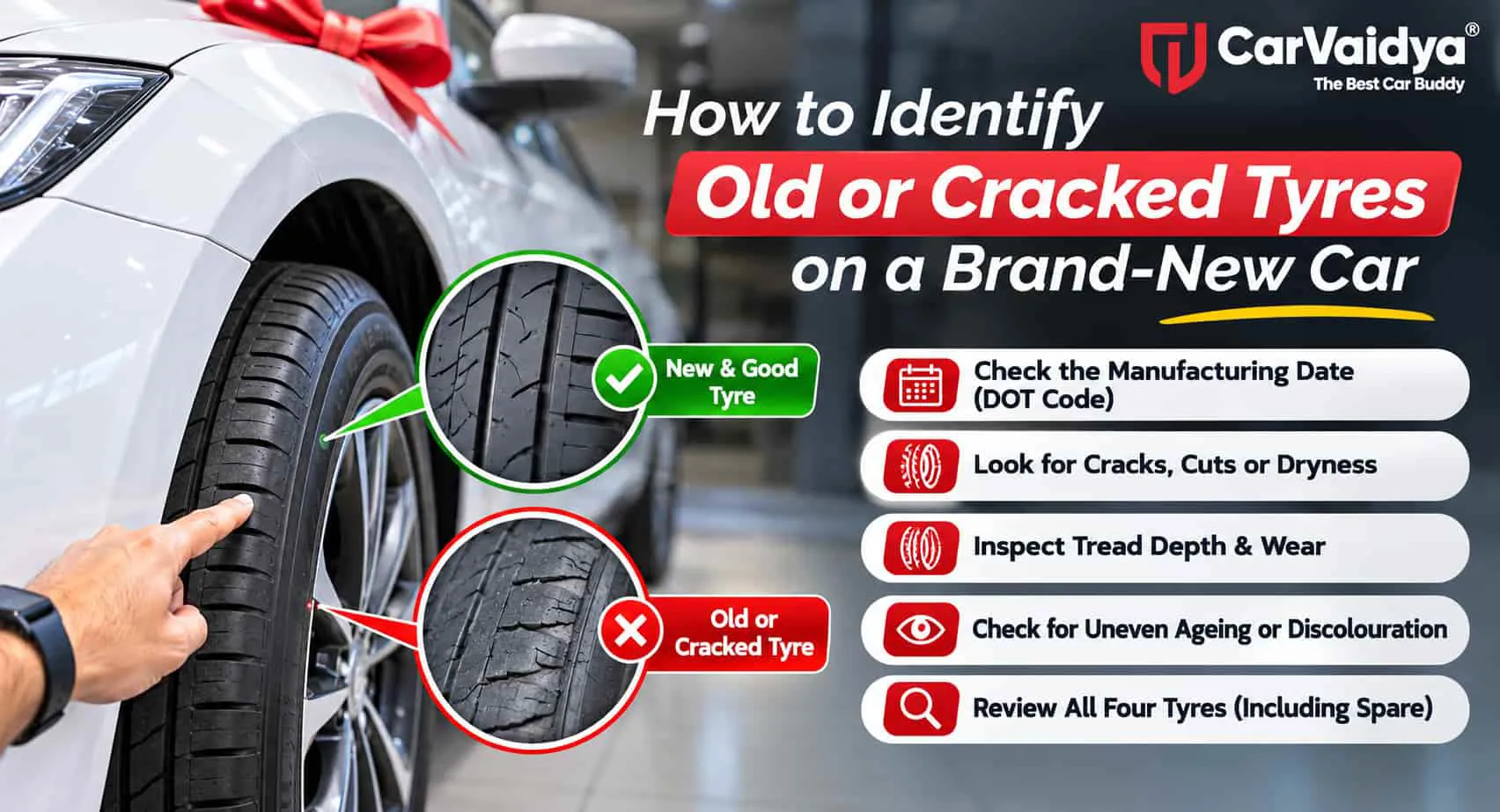
Look closely at the sidewalls in good light. Fine lines or a cobweb-like pattern of cracks, sometimes called weather cracking or dry rot, are signs of ageing rubber. Gently flex the sidewall with your thumb; small cracks open up and become easier to see.
2. Cracks in the tread grooves
Check the bottom of the tread grooves for fine cracks. These are less common on new tyres but can appear after long exposure to heat and sun.
3. Bulges or bubbles
A bulge on the sidewall usually means internal damage, often from hitting a pothole or kerb during transport or a test drive. A tyre with a bulge isn't safe and should be replaced.
4. Cuts, scrapes and kerb marks
Scrapes on the sidewall or rim suggest the car has been driven or parked carelessly. Deep cuts or exposed fabric are a definite reason to ask for a replacement.
5. Uneven or unusual wear
New tyres should have even tread all the way across. Wear on one edge, flat patches or bald spots mean the tyre has been used more than expected, or the car may have an alignment issue.
6. Faded, greyish rubber
Fresh tyres usually have a deep black look. A dull, greyish or chalky surface can be a sign of long sun exposure. On its own it isn't a defect, but it's a reason to check the date code and look closely for cracks.
Check Tread Depth
Tyres on a new car should have close to full tread depth. Many car tyres start somewhere around 7 to 8 mm, though this varies by brand and model.
- Look for the moulding pips or "nibs": New tyres often have small rubber hairs on the surface. Their presence is a good sign the tyre hasn't been used much.
- Check the tread wear indicators: These are small raised bars inside the main grooves. On a new tyre, they should sit well below the tread surface.
- Use a tread depth gauge: An inexpensive gauge gives an exact reading. All four tyres should read about the same.
Other Tyre Checks Before Delivery
- Same brand, size and model: All four tyres should match each other and match the specification in the owner's manual or brochure for your variant.
- Spare tyre: Check its date, condition and pressure, and make sure the jack and tools are present.
- Tyre pressure: Check pressures against the label on the driver's door frame. Cars are sometimes transported with higher pressures, which need to be corrected before you drive.
- Wheels and rims: Look for scratches, dents or bends on alloy and steel rims.
- Valve caps: They should be present on all tyres.
- Vibration on the test drive: A steering wheel that vibrates at certain speeds may point to flat spots, wheel balancing or a bent rim.
Quick Tyre Checklist for Delivery Day
- ☐ Date codes on all four tyres and the spare are recent and similar
- ☐ No sidewall or tread cracks
- ☐ No bulges, cuts or deep scrapes
- ☐ Even, near-full tread on all tyres
- ☐ Same brand, size and model as per specification
- ☐ Correct tyre pressure as per door label
- ☐ Rims free of scratches and dents
- ☐ No vibration during the test drive
What to Do If You Find a Problem
- Don't sign the delivery papers yet. Raise the issue with the delivery team first.
- Take clear photos of the date codes, cracks, bulges or damage on each tyre.
- Ask for replacement tyres if any tyre has cracks, a bulge, cuts, uneven wear, or is clearly much older than the rest.
- Ask about the car's stock history if all tyres are much older than expected. It may indicate the car has been in storage for a long time, and it's worth checking the rest of the car closely too.
- Get the commitment in writing. If the dealer agrees to replace tyres, note the details on the delivery documents or get it confirmed by email.
Book a CarVaidya Pre-Delivery Inspection
Tyres are just one part of a proper new car check. A CarVaidya Pre-Delivery Inspection (PDI) covers tyre dates and condition, panel gaps, paint, underbody, AC, electricals, fluids and a diagnostic scan, and gives you a clear report to share with the dealer before you take your new car home.
Frequently Asked Questions
How do I check the manufacturing date of a tyre?
Look for a four-digit code on the tyre's sidewall. The first two digits are the week and the last two are the year. For example, 2326 means the 23rd week of 2026.
How old can tyres be on a new car?
There's no fixed rule, but tyres made a few months before the car is normal. Tyres that are a year or more older than the car, or very different in age from each other, are worth raising with the dealer.
Are small cracks on a new tyre dangerous?
Fine surface cracks are a sign of ageing rubber and shouldn't be present on a new car's tyres. Deep cracks, cracks in the tread grooves or any bulges are a safety concern. Ask for the tyre to be inspected or replaced before delivery.
Should I check the spare tyre too?
Yes. Check the spare's date code, condition and pressure. It's easy to overlook, and you'll want it in good condition when you need it.
Can I ask the dealer to replace old tyres on a new car?
Yes, especially if the tyres are cracked, damaged, unevenly worn or clearly much older than expected. Raise it before you sign the delivery documents, when the dealer is most likely to act.
Why does my new car's steering vibrate?
It could be flat spots from long storage, unbalanced wheels or a bent rim. Mild flat spots sometimes disappear after a short drive. If the vibration continues, ask for wheel balancing and an inspection.
Checking tyres on a new car takes only a few minutes: read the date codes, look for cracks and damage, check the tread and pressure, and make sure all tyres match. If something looks wrong, raise it before you sign. Your new car should start its life on tyres that are as fresh and safe as the rest of it.
You can read some other articles
Top EV Charging Stations in Bangalore: Locations, Charging Costs & Complete Guide (2026)
Mukesh Ambani Car Collection: The World's Most Expensive Cars Owned by India's Richest Man
Top 10 Most Expensive Cars in India 2026: Prices, Features & Owners

0 Comments