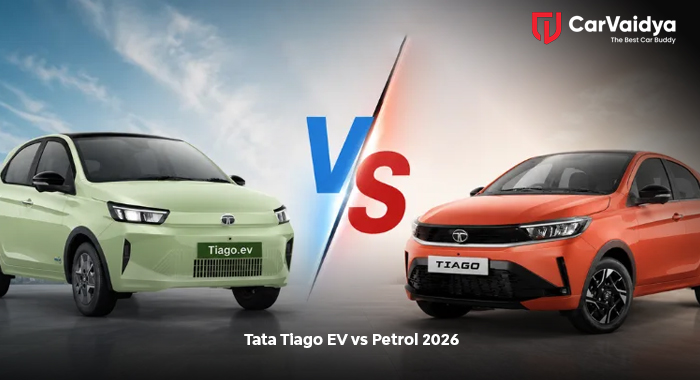
The Tata Tiago EV vs petrol comparison has become more important in 2026 as buyers look for a small city car that is affordable to own and easy to maintain. Both versions offer a practical hatchback package, but their ownership experience is quite different. The petrol Tiago gives you the convenience of quick refuelling and a familiar engine, while the Tiago EV offers much lower running expenses and a smoother automatic drive.
For 2026, Tata's Tiago EV is available with 19.2 kWh and 24 kWh battery options, while the petrol Tiago uses a 1.2-litre three-cylinder engine. The Tiago EV currently starts from around ₹6.99 lakh ex-showroom, with higher variants and battery options costing more. Prices can change with variants and offers.
Tiago EV vs Petrol 2026: Quick Comparison
| Parameter |
Tata Tiago EV |
Tata Tiago Petrol |
| Powertrain | Electric motor | 1.2L petrol engine |
| Battery/Engine | 19.2/24 kWh | 1199cc, 3-cylinder |
| Transmission | Automatic | 5-speed MT/AMT |
| Claimed EV range | Up to 285 km depending on version | Petrol mileage varies by driving conditions |
| Running cost | Usually below ₹1/km with home charging | Generally much higher |
| Tailpipe emission | Zero | Yes |
The Tiago petrol's 1.2-litre engine produces around 86 PS and 113 Nm, while the EV provides instant electric torque and automatic driving. Tata's current Tiago EV information lists up to 285 km ARAI range for the 24 kWh version, with a C75 real-world range of roughly 205–215 km.
Tiago EV vs Petrol Mileage and Range
When buyers search for Tiago EV vs petrol mileage, they should understand that EVs do not use mileage in kmpl. Instead, an EV uses electricity measured in kWh. The Tiago EV 24 kWh battery has an ARAI-certified range of up to 285 km, although real-world range depends on traffic, speed, air-conditioning, weather and driving style.
The petrol Tiago can travel several hundred kilometres after a full tank and takes only a few minutes to refuel. This makes petrol more convenient for long road trips, especially where charging stations are limited. For daily city driving, however, the EV's practical range is enough for most users who can charge at home.
Tiago EV vs Petrol Running Cost
The biggest difference appears in the Tiago EV vs petrol running cost. Home electricity can make the EV significantly cheaper to operate than petrol. For example, at an electricity price of ₹10 per unit, the 24 kWh Tiago EV needs roughly ₹240 for a theoretical full battery charge, before considering charging losses. Based on its certified range, this can bring energy cost to below ₹1 per km.
Petrol costs depend on the fuel price in your city and the actual mileage you get. If petrol costs around ₹100 per litre and the car delivers about 18–20 kmpl in mixed use, the fuel expense can be around ₹5–₹5.50 per km. Your actual figure will change according to traffic and driving habits.
Example for 1,000 km Monthly Driving
- Tiago EV: roughly ₹800–₹1,200 in electricity with economical home charging.
- Tiago Petrol: roughly ₹5,000 or more in petrol depending on mileage and fuel price.
This difference becomes very meaningful for people who drive to work every day. Public charging can cost more than home charging, so the cheapest EV ownership generally comes when you have convenient home charging.
Tiago EV vs Petrol Maintenance Cost
The Tiago EV vs petrol maintenance cost comparison also favours the electric model for routine maintenance. An EV does not have an engine, engine oil, spark plugs, clutch assembly or many of the moving components found in a petrol powertrain. This can reduce regular servicing requirements.
The petrol Tiago requires periodic engine oil and filter changes along with other engine-related checks. Over several years, these expenses can add up. The EV still needs tyre, brake, suspension, air-conditioning and other general vehicle maintenance, so it is not maintenance-free.
For hassle-free vehicle maintenance and repair support, owners can also explore CarVaidya for car service-related requirements.
Tiago EV vs Petrol 5 Year Cost
The Tiago EV vs petrol 5 year cost depends heavily on purchase price, financing, annual kilometres, electricity and petrol rates, insurance, servicing and resale value. The EV can have a higher purchase price in comparable variants, but its lower energy and routine maintenance expenses can recover part of that initial premium.
For example, if you drive 15,000 km every year, you cover around 75,000 km in five years. At ₹1 per km, EV energy expenditure would be around ₹75,000. At ₹5 per km, petrol expenditure would be around ₹3.75 lakh. This creates a potential difference of about ₹3 lakh in energy cost alone.
This is only an illustrative calculation. Actual five-year ownership cost will change based on electricity rates, fuel prices, driving efficiency, insurance, service bills, financing and resale value. Recent ownership analyses also highlight the EV's lower routine maintenance and running costs, while petrol cars can offer more predictable resale demand.
Tiago EV Charging Cost and Charging Time
The Tiago EV charging cost depends on your electricity tariff and charging source. Home charging is generally the most economical option. The Tiago EV supports 3.3 kW AC charging, 7.2 kW AC charging and DC fast charging. Tata says the 24 kWh battery can charge from 10% to 80% in around 35 minutes using a compatible DC fast charger in the newer charging setup.
For daily use, overnight home charging is more practical than depending on public fast chargers. Fast charging becomes useful during highway trips or when you need a quick top-up.
Tata Tiago EV Ownership Cost: What Matters Most?
Tata Tiago EV ownership cost should not be judged only by the ex-showroom price. Consider your yearly driving distance, home charging availability, electricity tariff, insurance, service requirements and expected resale value.
If you drive only a few thousand kilometres every year and do not have home charging, the petrol Tiago may remain the simpler financial choice. But if you drive 1,000–1,500 km every month, the EV's low energy cost can become a major advantage over time.
Tiago EV vs Petrol: Which Is Better?
So, Tiago EV vs petrol which is better? The answer depends on your usage.
- Choose Tiago EV if you mainly drive in the city, have home charging, cover high monthly kilometres and want lower running and routine maintenance costs.
- Choose Tiago Petrol if you frequently take long-distance trips, want quick refuelling and do not have reliable access to charging.
Overall, the Tiago EV makes stronger financial sense for regular city users who can charge at home. The petrol Tiago remains the more flexible option for buyers who prioritise easy refuelling and unrestricted long-distance travel. Before buying, calculate your own five-year cost using your local fuel and electricity prices. For many high-mileage city users in 2026, the Tiago EV can deliver the better ownership value.



 By CarVaidya
0 Comments