The government has
notified the final CAFE III norms, setting progressively tighter
fuel-efficiency targets for passenger vehicle makers from April 2027. The rules
give manufacturers multiple compliance routes, including higher credit
weightage for electric and hybrid vehicles.
The new rules apply to M1 category passenger
vehicles manufactured or imported in India from April 1, 2027 to March 31,
2032, per a Ministry of Power notification. Compliance will be calculated at
the manufacturer level using sales-weighted average fuel consumption.
CAFE III Targets Tighten Through FY2032
The
permitted fleet-average fuel consumption falls every year, calculated using the
formula a×(W-1,229)+c, where W is the weighted average unladen mass of all
eligible vehicles an OEM sells or imports. For a manufacturer with a reference
fleet weight of 1,229kg, the target drops from 3.996 litres of petrol
equivalent per 100km in FY2028 to 3.3273 litres per 100km in FY2032. That
corresponds to roughly 94.8g CO2/km in FY2028 and 78.9g/km in FY2032.
Financial Year | Permitted Fleetwide Average Fuel Consumption* |
|---|
FY28 | 3.996 litres/100 km |
FY29 | 3.860 litres/100 km |
FY30 | 3.7585 litres/100 km |
FY31 | 3.5313 litres/100 km |
FY32 | 3.3273 litres/100 km |
Targets are calculated across a manufacturer's
eligible fleet, so sales of more efficient vehicles can offset higher-consuming
models in the same portfolio. Small-volume manufacturers selling fewer than
1,000 eligible vehicles a year are exempt from meeting the specific target,
though they must still report fuel-consumption performance.
EVs and Hybrids Get
Super Credit Multipliers
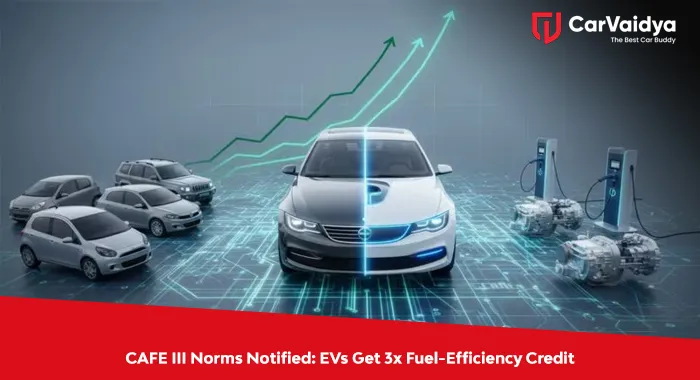
Battery electric and range-extended electric vehicles
receive a 3.0 super credit multiplier under CAFE III. Plug-in hybrids and flex-fuel
strong hybrids get a 2.5 multiplier, strong hybrids get 1.6, and flex-fuel
ethanol vehicles get 1.1.
| Vehicle Type | Multiplier |
|---|
| Battery Electric Vehicles (BEVs) | 3.0× |
| Range-Extended Electric Vehicles | 3.0× |
| Plug-in Hybrids | 2.5× |
| Flex-Fuel Strong Hybrids | 2.5× |
| Strong Hybrids | 1.6× |
| Flex-Fuel Ethanol Vehicles | 1.1× |
The final rules drop an additional 3g CO2/km benefit
for certain sub-four-metre petrol cars that had featured in an earlier CAFE III
draft.
Alternative Fuels and Efficiency Tech Also Earn
Credits
A Carbon Neutrality Factor gives further credit to alternative-fuel
vehicles. Cars running on E20 or higher ethanol-petrol blends, including strong
and plug-in hybrids, get an 8 percent carbon-neutrality factor on tailpipe CO2.
Flex-fuel ethanol vehicles get a 22.3 percent carbon-neutrality factor, CNG
vehicles get 5 percent or the notified CBG blending percentage, whichever is
higher, and diesel vehicles get a benefit linked to the notified biofuel
blending level. Manufacturers can also claim a 1g CO2/km reduction for each
eligible efficiency technology, up to a maximum of 9g CO2/km. The 12 eligible
technologies include start-stop systems, tyre-pressure monitoring, regenerative
braking, six-speed-or-higher transmissions, efficient alternators,
motor-generators, LED exterior lighting, advanced glazing, electric water pumps
and high-efficiency air-conditioning.
Credit Trading and WLTP Reporting Begin
CAFE III formalises a credit-and-debit system where compliance performance
carries financial value. Manufacturers beating their target generate credits,
while those exceeding their permitted fuel-consumption level accumulate debits,
tracked in a manufacturer-specific compliance passbook. Surplus credits can be
traded between manufacturers on mutually agreed terms, or bought from the
Bureau of Energy Efficiency to offset debits. The price rises from Rs 2,500 per
g CO2/km in FY2028 to Rs 4,500 per g CO2/km in FY2032. The five-year period
splits into two compliance blocks, FY2028-FY2030 and FY2031-FY2032. Credits and
debits carry forward within a block, but unused credits lapse once the block
ends. CAFE III also begins India's shift to the Worldwide Harmonised Light
Vehicles Test Procedure (WLTP) for efficiency calculations. From April 1, 2027,
manufacturers must declare CO2 performance under both the existing Modified
Indian Driving Cycle (MIDC) and WLTP, though the MIDC-to-WLTP conversion factor
is yet to be notified.
Source: https://www.drivespark.com/four-wheelers/2026/cafe-iii-norms-evs-get-3x-fuel-efficiency-credit-088277.html
 By CarVaidya



0 Comments