


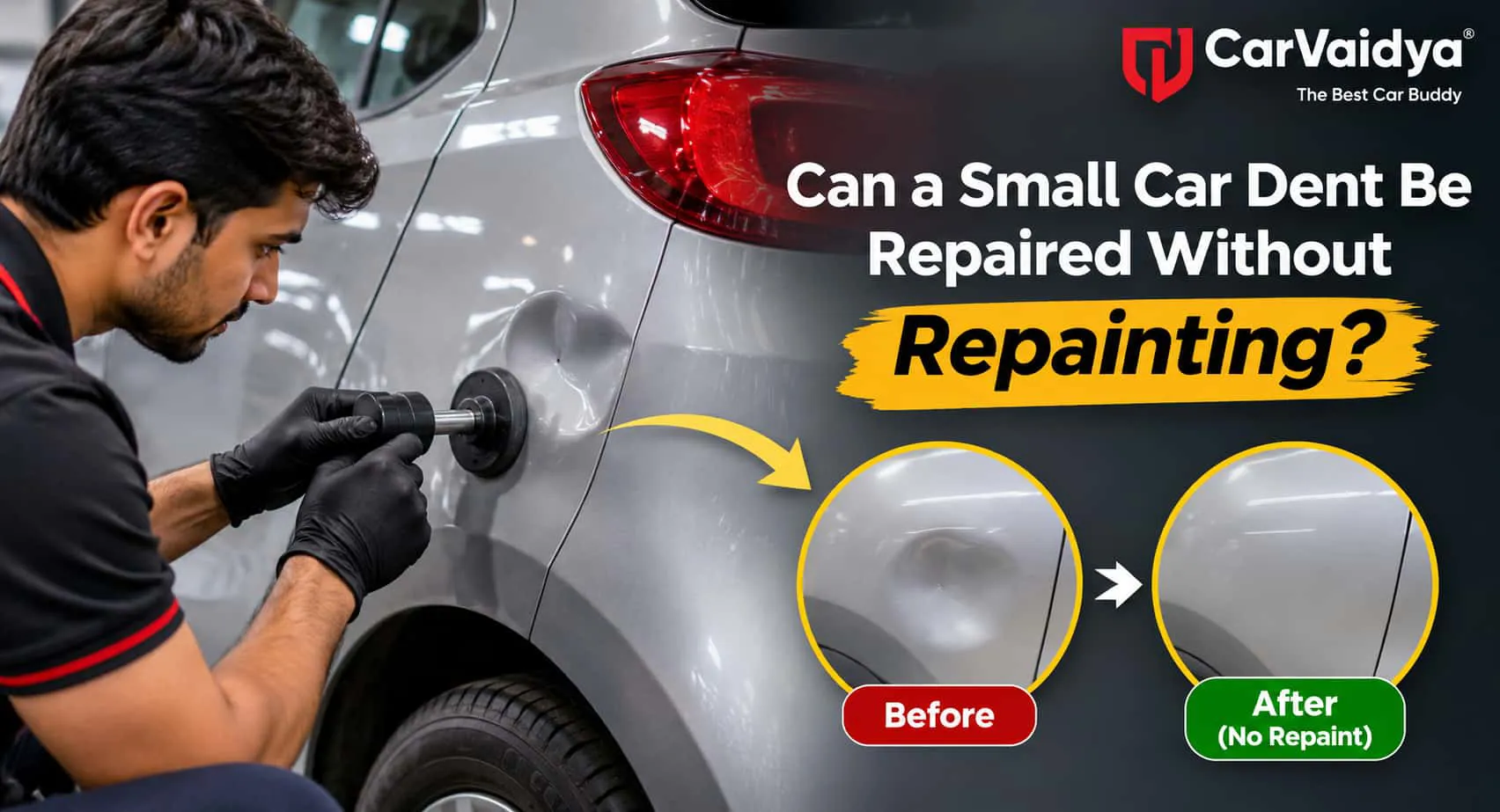
Can a Small Car Dent Be Repaired Without Repainting?
 By CarVaidya
- 05 Nov 2026
A door that swung into yours in a parking lot, a stray cricket ball, a bump from a scooter in traffic — small dents are part of driving in India. They don't affect how the car runs, but they're annoying to look at and can lower its resale value. Many owners put off fixing them because they assume a dent means repainting, which brings colour-matching worries and a day or two in the workshop.
The good news is that many small dents can be repaired without any repainting at all. This guide explains how that works, which dents qualify, when repainting is unavoidable, and what to expect from the repair.
Quick Answer
Yes. Many small car dents can be repaired without repainting using Paintless Dent Repair (PDR). A technician gently pushes or pulls the metal back into shape from behind the panel or with glue-pull tools, so the original factory paint stays intact. PDR works best on shallow, smooth dents where the paint isn't cracked, chipped, or scratched. If the paint is damaged, the dent sits on a sharp body line or panel edge, or the metal is stretched, conventional repair with repainting is usually needed.
What Is Paintless Dent Repair (PDR)?
Paintless Dent Repair is a technique for reshaping dented metal panels without sanding, filling or repainting. Modern car paint is quite flexible, so if a dent hasn't cracked it, the metal underneath can often be massaged back into its original shape while the paint simply moves with it.
Because the factory paint is preserved, there's no risk of colour mismatch, no overspray, and no long drying time. For the right kind of dent, the result can be close to invisible.
How Paintless Dent Repair Works
- Inspection under light: The technician uses a special light board or reflector to see the exact shape and depth of the dent. Small distortions that are hard to see in normal light become clear.
- Gaining access: Where possible, they reach the back of the panel by removing an inner trim, tail light, wheel liner, or using existing access holes.
- Pushing from behind: Using long metal rods and specialised tools, they apply slow, controlled pressure from behind the dent, working it out bit by bit.
- Glue pulling (if there's no access): On areas like roof rails or double-skinned panels, a tab is glued to the outside of the dent and pulled with a special tool. The glue then comes off without harming the paint.
- Tapping down high spots: Any raised areas around the dent are gently tapped down so the panel is level.
- Final check: The panel is checked again under light to make sure the surface is smooth and even.
A small, simple dent can often be repaired in under an hour. Larger or trickier ones may take a few hours.
Which Dents Can Be Fixed Without Repainting?
PDR usually works well for:
- Door dings from other car doors in parking lots
- Shallow, round dents from balls, knees or minor bumps
- Hail damage — small dents spread across the roof, bonnet or boot
- Soft creases that aren't too sharp or deep
- Dents on flat or gently curved areas of doors, fenders, bonnet, roof and boot lid
The key condition is that the paint is not broken. If the surface looks dented but the paint is still glossy and unbroken, PDR is worth asking about.
When Repainting Is Usually Needed
PDR isn't the answer for every dent. Conventional repair with filler and repainting is usually required when:
- The paint is cracked, chipped or scratched. Once the paint is broken, the area needs to be refinished to protect the metal from rust.
- The dent is very deep or sharp. When metal is stretched too far, it can't return to its original shape cleanly.
- The dent is on a sharp body line or panel edge. These areas are stiff and hard to reshape perfectly without other work.
- The panel has been repaired or repainted before. Old filler or thick aftermarket paint can crack when the metal is moved.
- The dent is on a plastic bumper. Bumpers need different repair methods, such as heat reshaping, and often some paint work.
- There's rust or structural damage around the dent.
Paintless Dent Repair vs Conventional Dent Repair
| Factor | Paintless Dent Repair | Conventional Repair |
|---|---|---|
| Paint | Original factory paint kept | Area sanded, filled, and repainted |
| Colour match | No risk of mismatch | Depends on the painter's skill and paint quality |
| Time | Often under an hour to a few hours | Usually one to three days, including drying |
| Cost | Usually lower for small dents | Higher, due to materials, paint, and labour |
| Resale value | Better — no repaint shows on a paint thickness check | Repainted panels can be detected during inspection |
| Best for | Small to medium dents with intact paint | Deep dents, damaged paint, edges, bumpers, rust |
Why Keeping the Original Paint Matters
Factory paint is applied in controlled conditions and baked for durability. Even a good workshop repaint can differ slightly in shade, texture, or thickness, and the difference sometimes becomes visible in sunlight or after a few months.
This matters when you sell the car. Used car buyers and inspectors often use a paint thickness gauge to find repainted panels, and multiple repaints can raise questions about accident history and bring down the price. A car with original paint generally holds its value better.
What Affects the Cost of Dent Repair Without Painting?
- Size and depth of the dent
- Location — dents near edges, body lines, or roof rails take more time
- Access — whether trims, lights, or liners need to be removed
- Panel material — aluminium panels are harder to work with than steel
- Number of dents — multiple dents, like hail damage, are usually priced as a package
For a single small dent, PDR is usually cheaper than conventional repair because there's no filler, primer, or paint involved. Ask for a quote after the technician inspects the dent, as prices vary by city and workshop.
Should You Try to Fix a Dent Yourself?
Online videos show quick fixes with suction cups, plungers, hair dryers, or boiling water. These sometimes work on large, shallow dents in flexible panels or plastic bumpers, but they can also make things worse.
- Pulling too hard can create high spots that are harder to fix than the original dent.
- Excess heat can damage the paint or clear coat.
- Cheap glue-pull kits can lift weak or previously repainted paint.
If you care about a clean finish, it's usually better to let a trained technician handle it. A poor DIY attempt can turn a paintless repair into one that needs repainting.
Don't Wait Too Long to Fix a Dent
A small dent with intact paint may not seem urgent, but delaying can make repair harder. Over time:
- Heat, sun, and vibration can cause tiny cracks in stressed paint.
- Once the paint cracks, moisture can reach the metal, especially in the monsoon, and rust can start.
- A dent that qualifies for PDR might later need repainting.
Getting it checked early gives you the best chance of a quick, paintless fix.
Is It Worth Claiming Insurance for a Small Dent?
Often not. For a small dent, the repair cost may be close to or lower than what you'd lose by giving up your No Claim Bonus (NCB) at renewal. Many owners pay for small dent repairs out of pocket and keep their NCB intact. For larger damage, compare the repair estimate with your NCB value before deciding.
Get Your Dent Checked by CarVaidya
Not sure whether your dent can be fixed without repainting? Book a car service or inspection with CarVaidya. Our technicians will assess the dent, tell you honestly whether paintless repair is possible, and recommend the right fix for your car.
Frequently Asked Questions
Can all small dents be fixed without repainting?
No. Paintless dent repair works when the paint is intact, and the metal isn't stretched too much. Dents with cracked or chipped paint, sharp creases, or damage on panel edges usually need repainting.
How long does paintless dent repair take?
A small, simple dent can often be repaired in under an hour. Larger dents or multiple dents, such as hail damage, may take several hours.
Will the dent be completely invisible after PDR?
For suitable dents, the result is often very hard to spot. Very deep or sharp dents may leave a slight mark, and a good technician will tell you this before starting.
Can dents on plastic bumpers be fixed without painting?
Sometimes. Shallow dents in plastic bumpers can often be pushed out with heat, but scuffs, cracks, or deep deformation usually need some refinishing.
Is paintless dent repair cheaper than repainting?
Usually, yes, for small dents. There's no filler, primer, or paint involved, and the job takes less time.
Does paintless dent repair affect resale value?
It generally helps resale value because the car keeps its original factory paint. Repainted panels can be detected by a paint thickness gauge during a used car inspection.
Final Thoughts
A small dent doesn't have to mean a repaint. If the paint is intact and the dent is in a reachable spot, paintless dent repair can restore the panel quickly, keep the factory finish, and protect your car's resale value. The sooner you get it checked, the better your chances of a clean, paintless fix.
You can read some other articles
Why Is My Car Mileage Suddenly Decreasing? 15 Causes and How to Fix Them
Check Engine Light On, but Car Runs Normally: Causes, Risks and Solutions
How to Check Car Loan Hypothecation on RC and Remove It After Loan Closure

0 Comments