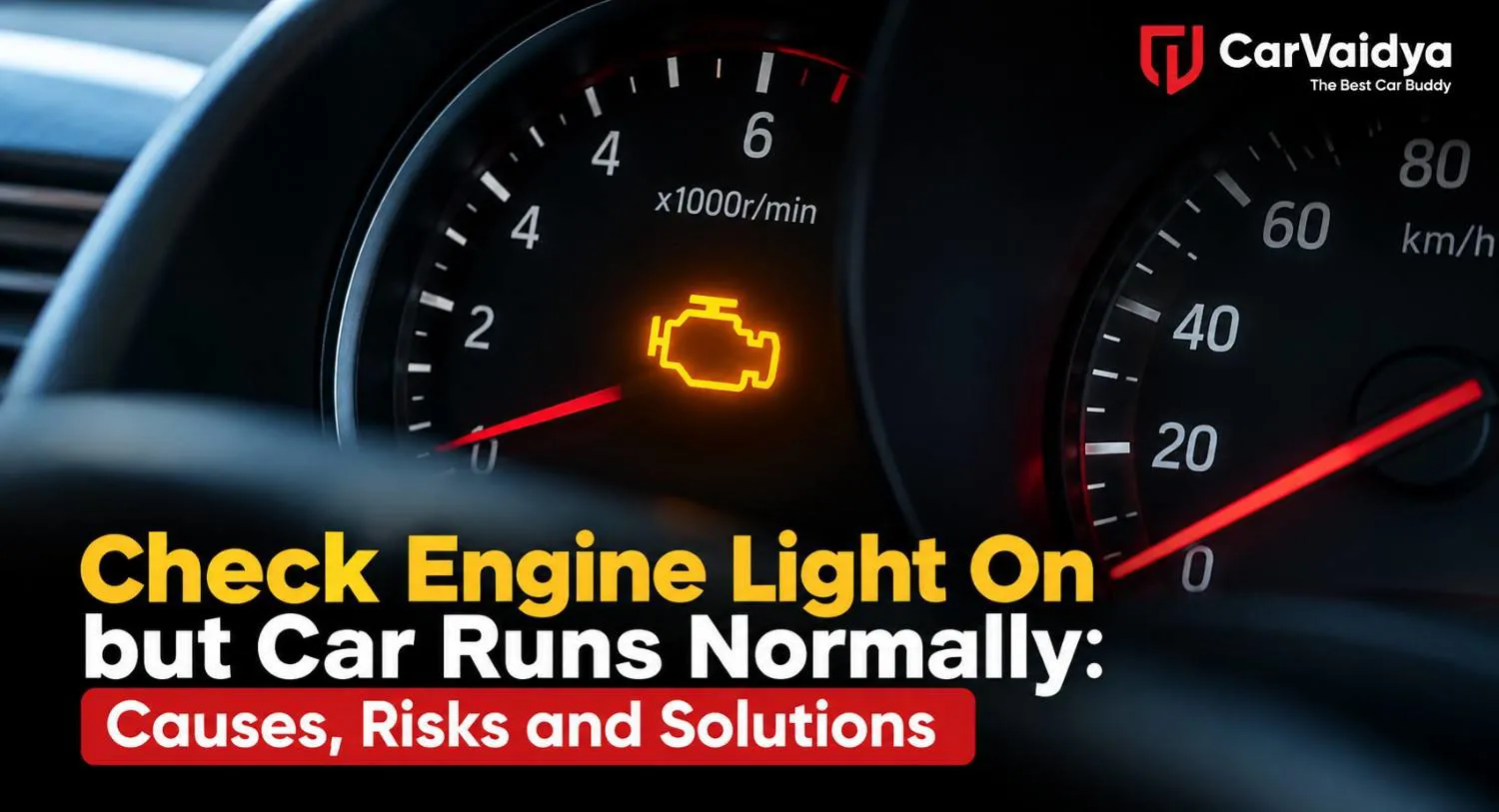
You start the car, glance at the dashboard and there it is: a small amber engine symbol that wasn't there yesterday. The car starts fine. It idles smoothly. It pulls well on the road. So what's the problem?
This is one of the most common situations Indian car owners face, and also one of the most ignored. A check engine light on a car that feels perfectly normal doesn't always mean trouble, but it is never there for no reason. Your car's computer has spotted something it doesn't like, and the sooner you find out what, the cheaper the fix usually is.
In this guide, we'll walk through what the light actually means, the most likely causes, how risky it is to keep driving, and exactly what you should do next.
Quick Answer
If your check engine light is steady (not blinking) and the car drives normally, it's usually safe to drive for a short time, but get it scanned within a few days. If the light is flashing, reduce speed and get the car checked immediately, as it signals a serious misfire that can damage the catalytic converter.
What Does the Check Engine Light Actually Mean?
Every modern car sold in India has an Engine Control Unit (ECU) that constantly monitors sensors across the engine, fuel system, ignition system and exhaust. When one of those readings falls outside the expected range, the ECU stores a fault code and switches on the check engine light, also called the Malfunction Indicator Lamp (MIL).
The important thing to understand is that the light doesn't wait for your car to feel sick. It often comes on at the very first sign of a problem, long before you notice any change in performance, mileage or sound. That is exactly why the car can feel completely normal while the warning is on.
Steady Light vs Flashing Light
Not all check engine warnings are equal. The way the light behaves tells you a lot about how urgent the issue is.
| Light Behaviour |
What It Usually Means |
What You Should Do |
| Steady amber/yellow |
A non-critical fault has been detected, such as a sensor issue or emission-related problem |
Drive carefully and get a diagnostic scan within a few days |
| Flashing / blinking |
Active engine misfire; unburnt fuel is entering the exhaust |
Slow down, avoid heavy load and get it checked the same day |
| Comes on and goes off |
An intermittent fault that appears under certain conditions |
The code is still stored in the ECU, so get it scanned |
| Red engine or oil/temperature warning |
A different, more critical warning (low oil pressure or overheating) |
Pull over safely and switch off the engine |
Common Causes of Check Engine Light When the Car Runs Normally
When the car shows no symptoms, the cause is usually something small or something in its early stages. Here are the most frequent culprits mechanics see.
1. Loose or Faulty Fuel Cap
It sounds too simple, but it's one of the top reasons. A fuel cap that isn't tightened properly after refuelling, or one with a worn rubber seal, lets fuel vapour escape. The evaporative emission (EVAP) system detects the leak and triggers the light. Tighten the cap until it clicks, and the light may switch off on its own after a few drive cycles.
2. Oxygen (O2) Sensor Problem
The oxygen sensor measures how much unburnt oxygen is in the exhaust and helps the ECU balance the air-fuel mixture. When it starts to fail, the car may still drive smoothly, but fuel economy slowly drops. Left unattended, a bad O2 sensor can eventually harm the catalytic converter.
3. Worn Spark Plugs or Weak Ignition Coil
Spark plugs wear out gradually. In the early stages, you may not feel any jerk or hesitation, but the ECU picks up small inconsistencies in combustion. If ignored, this turns into a noticeable misfire and a flashing light.
4. Mass Air Flow (MAF) Sensor Issue
The MAF sensor measures the air entering the engine. Dust, oil from aftermarket air filters or a dirty intake can throw off its readings. Dusty Indian road conditions make this a fairly common fault, and sometimes a careful cleaning is all it needs.
5. Catalytic Converter Efficiency
A code related to the catalytic converter often appears on older or high-mileage cars. The car may run fine, but the converter is no longer cleaning exhaust gases efficiently. This one needs proper diagnosis, as a replacement is one of the more expensive repairs.
6. Aftermarket CNG Kits or Electrical Accessories
This is a very India-specific cause. Poorly installed CNG kits, aftermarket LED lights, alarms or music systems can interfere with sensor wiring or voltage. Many cars running on retro-fitted CNG show a check engine light even when they feel perfectly fine on petrol and gas.
7. Weak Battery or Charging Problems
A battery that's ageing or an alternator not charging properly can cause voltage drops. Sensitive electronics react to this, and the ECU may log faults that have nothing to do with the engine itself.
8. Poor Quality Fuel
Contaminated or adulterated fuel can affect combustion and sensor readings. If the light appeared right after refuelling at an unfamiliar pump, this could be the reason.
Causes, Risk Level and Approximate Repair Cost at a Glance
Here's a quick comparison to help you understand how serious each issue is. Costs are approximate for popular hatchbacks and sedans in India and vary by car model, brand and city.
| Cause |
Risk Level |
Approx. Cost (₹) |
| Loose / faulty fuel cap |
● Low |
0 – 1,000 |
| MAF sensor (cleaning / replacement) |
● Medium |
500 – 8,000 |
| Spark plugs / ignition coil |
● Medium |
1,000 – 6,000 |
| Oxygen (O2) sensor |
● Medium |
2,500 – 8,000 |
| Battery / alternator issue |
● Medium |
3,500 – 12,000 |
| CNG kit / wiring fault |
● Medium |
500 – 5,000 |
| Catalytic converter |
● High |
15,000 – 60,000+ |
Is It Safe to Keep Driving With the Check Engine Light On?
The honest answer: for a short while, usually yes, as long as the light is steady and the car behaves normally. But "the car feels fine" is not the same as "nothing is wrong."
Risks of Ignoring the Warning
- Small problems become big bills: A ₹3,000 sensor issue can lead to a ₹40,000 catalytic converter replacement if left for months.
- Drop in mileage: Faulty sensors often make the engine burn more fuel than needed, quietly increasing your running cost.
- Failed PUC test: Many emission-related faults can cause your car to fail its Pollution Under Control check.
- Hidden second fault: While the light is already on, a new and more serious problem won't give you a fresh warning.
- Lower resale value: Buyers and inspectors treat an active check engine light as a red flag.
When You Should Stop Driving Immediately
- The check engine light is flashing
- You notice jerking, shaking or loss of power
- There's a burning smell or smoke from the bonnet or exhaust
- The temperature gauge is rising towards the red zone
- The oil pressure warning light comes on alongside it
In any of these cases, pull over safely and call for roadside assistance rather than risking engine damage.
What To Do When the Check Engine Light Comes On
Follow these steps in order. They'll help you figure out whether it's a quick fix or something that needs a mechanic.
Step 1: Check the fuel cap. Remove it, inspect the seal and tighten it until it clicks.
Step 2: Watch for symptoms. Note any change in mileage, idle, pickup, smell or sound over the next few drives.
Step 3: Check other warning lights and gauges. Make sure temperature and oil pressure are normal.
Step 4: Get an OBD-II scan. A diagnostic scanner reads the exact fault code stored in the ECU and tells you where the problem lies.
Step 5: Fix the root cause, not just the light. Avoid clearing the code without repair. It will simply come back.
Why You Shouldn't Just Disconnect the Battery
Some people disconnect the battery to reset the light. While this may turn it off temporarily, it also erases the stored fault data that a technician needs for diagnosis. If the underlying problem is still there, the light will return within a few days. A proper car inspection with a diagnostic scan is a far better approach.
How to Prevent Check Engine Light Problems
Most check engine warnings can be avoided with basic, regular care:
- Follow your car's recommended service schedule
- Replace spark plugs and air filters on time
- Refuel at trusted fuel stations
- Always tighten the fuel cap properly after refuelling
- Get CNG kits and electrical accessories installed only by authorised professionals
- Test your battery health before summer and monsoon
- Consider an annual maintenance contract (AMC) so servicing never gets delayed
Planning to buy a used car? Always check whether the check engine light is on during the test drive, and book a pre-purchase used car inspection before you pay.
Frequently Asked Questions
Can a check engine light turn off by itself?
Yes. If the fault was temporary, like a loose fuel cap, the light may switch off after a few normal drive cycles. However, the fault code usually stays stored in the ECU for some time.
How long can I drive with the check engine light on?
With a steady light and no symptoms, you can usually drive for a few days, but it's best to get it scanned within a week. With a flashing light, get it checked immediately.
Will the check engine light affect my PUC certificate?
It can. Many faults that trigger the light are emission-related and can cause the car to fail the PUC test.
Does a check engine light mean my engine is damaged?
Not necessarily. In most cases where the car runs normally, it points to a sensor, ignition or emission component rather than internal engine damage.
Can low engine oil turn on the check engine light?
Low oil usually triggers the separate oil pressure warning light. That said, oil-related issues can affect certain sensors, so check your oil level if both lights come on.
Final Thoughts
A check engine light on a car that runs normally is your car's way of asking for attention early, before the problem becomes expensive. It may be something as simple as a loose fuel cap, or it may be the first sign of a failing sensor. Either way, a quick diagnostic scan gives you clarity and peace of mind.
Don't wait for symptoms to show up. Book a professional car inspection and find out exactly what your dashboard is trying to tell you.


 By CarVaidya
0 Comments