


Car Documents Checklist for 2026: RC, Insurance, PUC and Driving Licence
 By CarVaidya
- 29 Oct 2026
Getting stopped at a traffic checkpoint is stressful enough without having to search the glovebox for papers. In 2026, it matters more than ever to keep your car documents valid and handy. Enforcement is now largely digital, with cameras and e-challans, and new rules mean repeated violations can put your driving licence at risk.
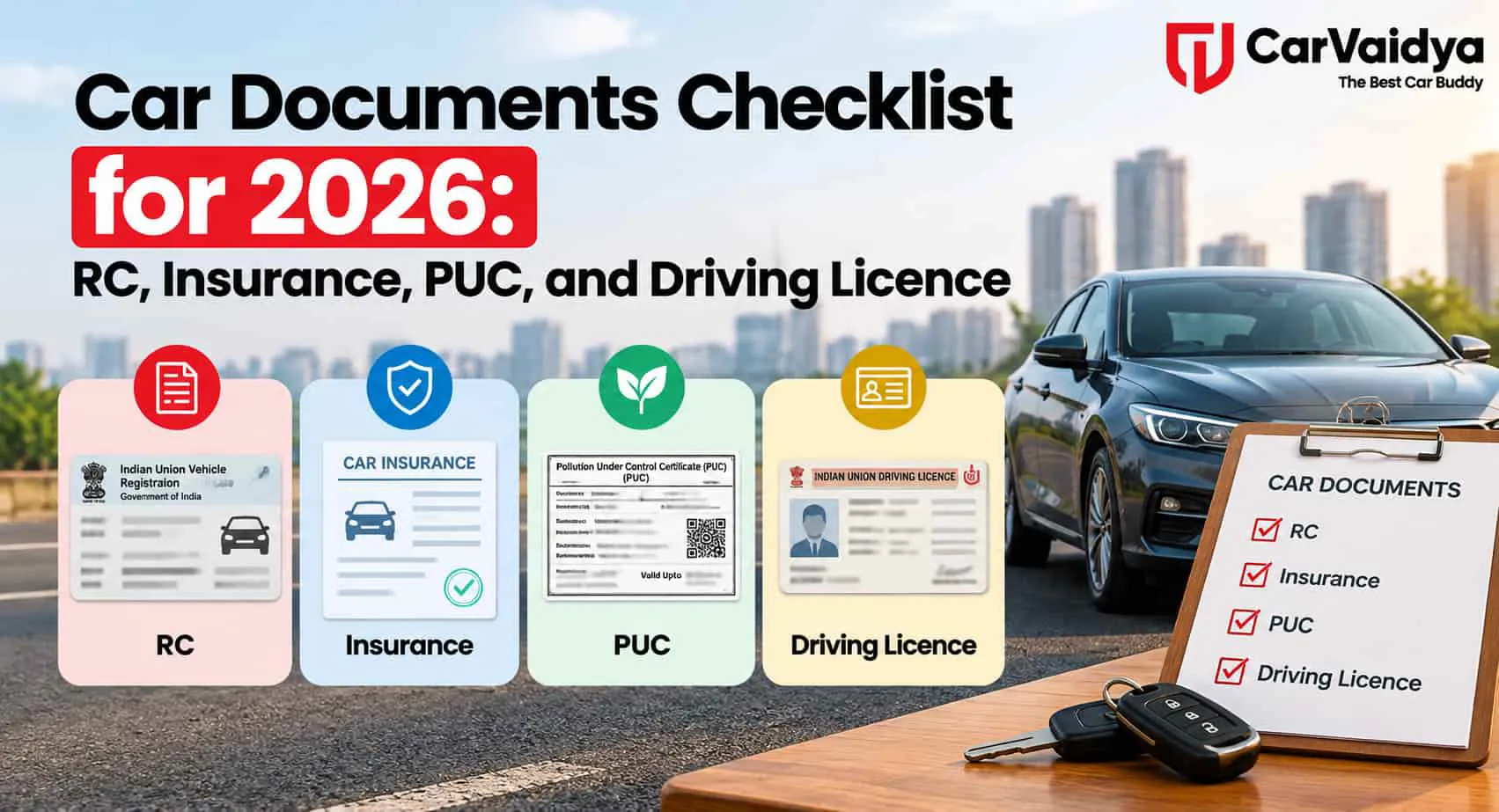
This checklist covers the four documents every car owner in India needs, how long each one is valid, the penalties for missing them, and the rule changes you should know about this year.
Quick Answer
To drive a private car legally in India in 2026, you need four documents: a valid Driving Licence (DL), the car's Registration Certificate (RC), a valid motor insurance policy (at least third-party), and a valid Pollution Under Control (PUC) certificate. Digital copies stored in DigiLocker or the mParivahan app are legally accepted in place of physical documents.
The 4 Mandatory Car Documents at a Glance
| Document | What it proves | Typical validity | Fine if missing* |
|---|---|---|---|
| Driving Licence | You're authorised to drive this class of vehicle | 20 years or until age 40, whichever comes first; then periodic renewals | ₹5,000 |
| Registration Certificate (RC) | The car is legally registered, and who owns it | 15 years for private cars; renewable in 5-year blocks | Up to ₹5,000 (varies by state) |
| Motor Insurance | Third-party liability is covered | Usually 1 year (longer for new cars) | ₹2,000 first offence; ₹4,000 repeat |
| PUC Certificate | The car meets emission norms | About 1 year for a new car; then as printed on the certificate | Up to ₹10,000 (varies by state) |
*Maximum penalties are set by the Motor Vehicles (Amendment) Act, 2019, but actual challan amounts are decided by each state and can differ. Imprisonment may also apply for some offences.
1. Driving Licence (DL)
Your driving licence is personal to you, not the car. It shows you've passed the required test and are allowed to drive a specific class of vehicle — for most car owners, that's LMV (Light Motor Vehicle).
What to check
- The licence hasn't expired.
- It covers the right vehicle class (LMV for cars).
- Your address and photo are up to date, especially if you've moved cities.
Why it matters beyond the fine
If you're in an accident while driving without a valid licence, your insurer can refuse the claim or recover the payout from the owner. That can be far more expensive than any challan.
2. Registration Certificate (RC)
The RC is your car's identity document. It's issued by the RTO and records the registration number, owner's name, chassis and engine numbers, fuel type and registration validity. It also shows hypothecation if the car was bought on loan.
What to check
- The owner name and address are correct.
- Chassis and engine numbers match the car.
- Registration validity hasn't expired, especially for cars close to 15 years old.
- If your car loan is closed, hypothecation has been removed at the RTO. Paying off the loan alone doesn't update the RC.
- Any CNG kit or other approved modification is endorsed on the RC.
3. Motor Insurance
Third-party insurance is compulsory under Section 146 of the Motor Vehicles Act. It covers your legal liability if your car injures someone or damages their property. A comprehensive policy adds cover for damage to your own car, theft, fire and natural disasters, and is strongly recommended.
What to check
- The policy end date — set a reminder a few weeks before renewal.
- Registration number, chassis number and owner name match the RC.
- Your No Claim Bonus (NCB) carries over at renewal. A lapse of more than 90 days usually means losing it.
- If you've sold or bought a used car, the policy has been transferred to the new owner.
Insurance updates to watch in 2026
In August 2026, the Supreme Court directed IRDAI and the Ministry of Road Transport and Highways to design a pilot under which vehicles without valid insurance could be refused fuel at petrol pumps. The same order extended mandatory long-term third-party cover for new cars from three to four years. A proposal to raise the no-insurance fine is pending but not yet notified, so the ₹2,000 and ₹4,000 penalties still apply for now.
4. Pollution Under Control (PUC) Certificate
The PUC certificate confirms that your car's emissions are within permitted limits. It's issued after a quick test at an authorised PUC centre, usually found at fuel stations. Many owners forget it, but it's mandatory and the penalty can be steep.
What to check
- The validity date printed on the certificate. A new car's first PUC usually lasts about a year from registration; after that, renewal periods are shorter.
- That the certificate is linked to your vehicle on the VAHAN database, so it shows up when checked digitally.
Some insurers also check PUC status at renewal or during a claim, and in Delhi, enforcement drives have tied PUC to fuel purchases. Renewing it on time is simple and saves a lot of trouble.
Are Digital Car Documents Valid in 2026?
Yes. Under the Central Motor Vehicles Rules, digital versions of your driving licence, RC, insurance and PUC stored in DigiLocker or the official mParivahan app are treated as valid documents. Traffic police can also verify them directly from the government database using your registration or licence number.
How to keep your documents digitally
- Download DigiLocker or mParivahan from the official app store. Make sure the publisher is the Government of India.
- Sign in with your mobile number linked to Aadhaar.
- Add your driving licence using your DL number and date of birth.
- Add your vehicle RC using the registration number and the last few digits of the chassis number.
- Many insurers also push policies to DigiLocker. Otherwise, keep a PDF of the policy on your phone.
Note: A photo or scanned copy in your phone's gallery is not the same as a document issued through DigiLocker or mParivahan, and may not be accepted.
New Rules in 2026 That Affect Car Owners
Five offences in a year can cost you your licence
The Central Motor Vehicles (Third Amendment) Rules, 2026, notified in January, added a new ground for licence disqualification: committing five or more offences in a year, counted from January 1, 2026. This applies even to common violations, not just serious ones. Expired documents can lead to challans that count towards this total.
Tighter timelines for challans
The same amendment introduced a 45-day window to pay or contest an e-challan. Unpaid challans can block services such as licence renewal, RC transfer or vehicle sale. It's worth checking the e-Challan portal regularly, even if you don't remember being stopped, since many challans are now camera-generated.
Proposed driving licence changes
In October 2026, the government proposed further driving licence changes, including a higher pass mark for the learner's licence test and a wider list of accepted identity documents. These are draft proposals and may change before they're finalised.
Other Documents Worth Keeping Handy
These aren't required during a traffic check, but you'll need them at some point:
- FASTag – required for paying tolls on national highways.
- Loan closure letter and bank NOC – needed to remove hypothecation from the RC.
- Service history and invoices – useful for warranty claims and to improve resale value.
- Purchase invoice – helpful for insurance claims and ownership disputes.
- Roadside assistance contact – save it in your phone along with your insurer's claim number.
Your Quick Car Document Checklist
- ☐ Driving licence valid and covers LMV
- ☐ RC details correct, registration valid, hypothecation removed if loan is closed
- ☐ Insurance active, details match RC, renewal date noted
- ☐ PUC valid and linked to VAHAN
- ☐ All four documents added to DigiLocker or mParivahan
- ☐ No pending challans on the e-Challan portal
- ☐ FASTag active with enough balance
A five-minute check every few months is enough to stay on top of everything.
Need Help With RTO Work or Challans?
From RC transfers and hypothecation removal to checking and settling pending challans, CarVaidya can help you handle RTO and challan-related services without the usual running around. Keep your paperwork in order so you can focus on the drive.
Frequently Asked Questions
What documents are mandatory to drive a car in India in 2026?
You need a valid driving licence, the car's registration certificate, a valid motor insurance policy (at least third-party), and a valid PUC certificate. Commercial vehicles also need a fitness certificate and permit.
Can I show car documents on my phone instead of carrying originals?
Yes, as long as they're in DigiLocker or the official mParivahan app. These digital documents are legally valid. A plain photo or scan saved in your gallery may not be accepted.
What is the fine for driving without a PUC certificate?
The Motor Vehicles Act allows a penalty of up to ₹10,000, and some states also apply licence disqualification. Actual challan amounts vary by state.
What happens if my car insurance has expired?
Driving without insurance attracts a fine of ₹2,000 for a first offence and ₹4,000 for a repeat offence, and the vehicle can be seized. More importantly, you'll be personally liable for any third-party damage or injury in an accident.
Can my driving licence be suspended for unpaid challans?
Yes. Under the 2026 amendment, five or more offences in a calendar year can lead to licence disqualification, and unpaid challans can block services like licence renewal and RC transfer.
How do I check whether my car documents are valid?
Enter your registration number on the mParivahan app or the Parivahan VAHAN portal. It shows registration, insurance, and PUC validity. Licence details can be checked using your DL number on the Parivahan website.
Final Thoughts
Keeping your car documents in order isn't complicated. Four documents, a few renewal dates, and a digital backup are all it takes. With stricter rules and camera-based enforcement in 2026, a missed PUC or expired policy is more likely to catch up with you than before. A quick check every few months keeps you legal, protected, and stress-free on the road.
You can read some other articles
Mahindra Thar Roxx vs Tata Sierra 2026
Maruti Suzuki Grand Vitara vs Hyundai Creta 20
Safest Cars Under ₹10 Lakh in India (2026)

0 Comments