


No Service Book? 6 Ways to Investigate a Used Car's Past
 By CarVaidya
- 02 Nov 2026
You've found a used car that looks right and fits your budget. Then the seller says, "The service book got lost." It's a common story. Service books do go missing, especially after a few owners or a house move. But without one, you have no easy way to know whether the car was serviced on time, has been in an accident, or has had its odometer rolled back.
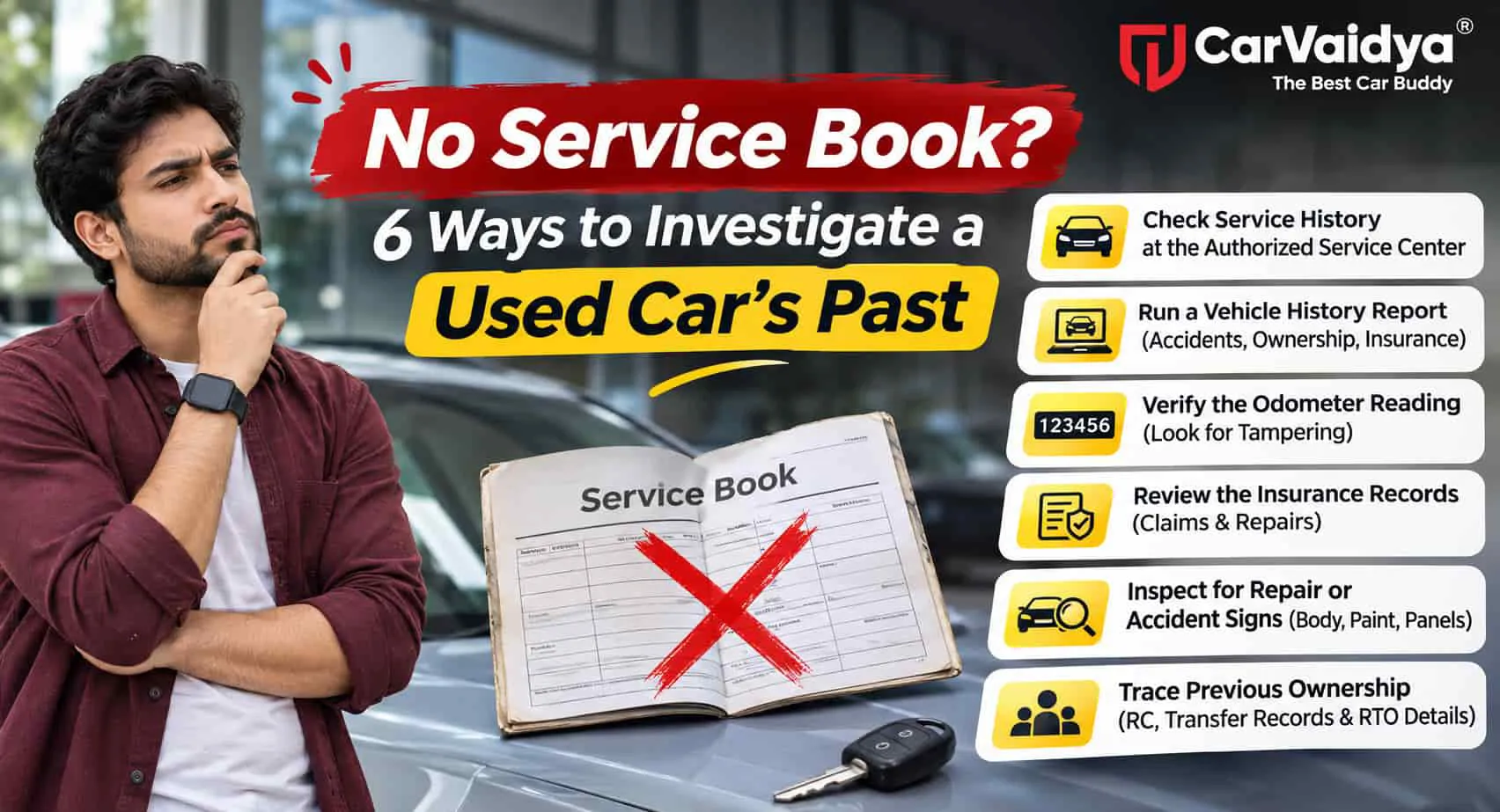
A missing service book doesn't automatically mean you should walk away. It just means you need to do a bit more homework. Here are six practical ways to piece together a used car's history before you buy it.
Quick Answer
If a used car has no service book, you can still check its history by: (1) asking an authorised service centre to pull records using the registration or chassis number, (2) checking past insurance policies and No Claim Bonus for accident claims, (3) looking up registration, ownership, loan and challan details on VAHAN or mParivahan, (4) running an OBD scan for stored faults, (5) following the paper trail and physical clues like old invoices, tyre and battery dates, and (6) getting a professional pre-purchase inspection.
Why a Missing Service Book Matters
A service book is a simple record of when the car was serviced, at what mileage, and what was replaced. It helps you answer three important questions:
- Was the car maintained properly? Regular oil changes and timely part replacements make a big difference to engine life.
- Is the odometer reading genuine? Mileage recorded at each service makes tampering easier to spot.
- Are big expenses coming up? If the timing belt, clutch, or battery hasn't been changed in a long time, you'll be paying for it soon.
Without the book, you have to find these answers another way.
1. Ask an Authorised Service Centre for Records
If the car was ever serviced at an authorised dealer workshop, there's a good chance the records are still in the manufacturer's system, even if the paper book is gone. Service centres can usually look up a car's history using the registration number or chassis number (VIN).
How to do it
- Take the seller along to the nearest authorised service centre of that brand, or ask them to request a printout.
- Some brands let owners view service history in their official app or website. Ask the seller to log in and show you.
- Look for service dates, odometer readings at each visit, major repairs, and any accident-related bodywork.
What it tells you: service regularity, mileage trend, major part replacements, and sometimes past accident repairs.
Limitations: it won't show work done at local garages. Many owners switch to independent workshops once the warranty ends, so gaps in dealer records aren't always a bad sign — but they're worth asking about.
2. Check Insurance Policies and Claim History
Insurance records are one of the best clues to a car's accident history, because major repairs are usually done through an insurance claim.
What to ask for
- The current and previous insurance policies. Check the No Claim Bonus (NCB) percentage. A high NCB, such as 45 or 50 percent, means several claim-free years. An NCB that has dropped to zero suggests a recent claim.
- Claim details. Ask the seller directly whether any claims were made, and for what. Large claims for front-end or structural damage deserve a closer look.
- Insurance continuity. Long gaps without insurance can mean the car was off the road, possibly after an accident or flood.
What it tells you: whether the car has had significant insured damage, and how carefully it has been owned.
3. Look Up Official Records on VAHAN or mParivahan
Government records won't show service history, but they confirm the car's basic identity and paperwork, which is just as important. Enter the registration number on the Parivahan VAHAN portal or the official mParivahan app.
| What to check | Why it matters |
|---|---|
| Registration date | Confirms the car's real age |
| Owner name and ownership serial | Shows whether the seller is the owner and roughly how many owners it has had |
| Fuel type and vehicle class | Reveals unapproved CNG fitments or past commercial/taxi use |
| Hypothecation | Shows whether there's an active loan on the car |
| Insurance and PUC validity | Needed for a smooth RC transfer |
Also check the e-Challan portal. Frequent speeding or rash driving challans can say a lot about how the car has been driven. Pending challans also need to be cleared before transfer.
4. Run an OBD Diagnostic Scan
Almost every modern car has an OBD (On-Board Diagnostics) port, usually under the dashboard near the steering. Plugging in a scanner lets you read the car's electronic memory.
What an OBD scan can reveal
- Stored fault codes – problems with the engine, gearbox, sensors, airbags or ABS, even if no warning light is on right now.
- Recently cleared codes – if the codes were wiped just before your visit, some system readiness monitors will show as "not ready." That's a sign someone may be hiding a problem.
- Mileage clues – on some cars, certain control units store their own distance or running-time data. A mismatch with the dashboard odometer can point to tampering.
Basic Bluetooth OBD scanners are inexpensive, but a professional inspector with a brand-level diagnostic tool will get much more detailed information.
5. Follow the Paper Trail and Physical Clues
Even without a service book, most cars leave small traces of their past. Put them together like a detective.
Paperwork to ask for
- Invoices from local garages, tyre shops or battery dealers
- The original purchase invoice and warranty papers
- Old PUC certificates and insurance renewals, which help build a timeline
- WhatsApp messages or emails from a garage — many local mechanics share bills digitally
Physical clues on the car
- Service stickers – check the windscreen corner and under the bonnet for oil-change stickers with dates and mileage.
- Tyre dates – the four-digit code on the tyre sidewall shows the week and year of manufacture. Original tyres on a car claiming high mileage, or brand-new tyres on a low-mileage car, both deserve questions.
- Battery date – usually printed on the battery label. It shows when it was last replaced.
- Wear vs. odometer – a worn steering wheel, shiny gear knob, sagging driver's seat or worn pedal rubbers on a car showing low kilometres suggest the odometer may not be genuine.
Talk to the previous owner
If you're buying through a dealer or the car has had multiple owners, ask whether you can speak to the previous owner. A two-minute call about how the car was used, where it was serviced, and whether it was ever in an accident can be surprisingly revealing.
6. Get a Professional Pre-Purchase Inspection
When records are incomplete, the car itself becomes the most reliable source of truth. A trained inspector knows exactly where to look for signs that paperwork won't show.
What a good inspection covers
- Accident repairs – paint thickness checks, uneven panel gaps, mismatched paint, and signs of welding on the structure.
- Flood damage – rust under the seats and carpets, water marks, musty smells and corroded electrical connectors.
- Engine health – oil leaks, smoke, unusual noises, coolant condition and compression concerns.
- Gearbox and clutch – smoothness of gear changes, clutch slip and transmission noises.
- Suspension, brakes and steering – worn bushes, leaking shock absorbers, brake pad and disc wear.
- Electricals – AC, power windows, lights, infotainment and battery health.
- Diagnostic scan – fault codes and system readiness.
A detailed inspection report also gives you solid ground to negotiate the price, or the confidence to walk away.
Red Flags When There's No Service Book
- The seller can't explain where the car was serviced at all
- Very low kilometres on an older car, with no records to support it
- Interior wear that doesn't match the odometer reading
- NCB reset to zero, with no clear explanation of the claim
- Fault codes recently cleared before your visit
- The seller refuses to let you take the car for an inspection
- The price is noticeably lower than similar cars, without a good reason
Should You Still Buy a Car Without a Service Book?
It depends on what your investigation turns up. If dealer records, insurance history, official records and a professional inspection all point to a well-kept car, a missing book is a small issue — and possibly a reason to negotiate a slightly better price.
If, on the other hand, there are gaps you can't explain, signs of tampering, or a seller who resists checks, it's usually wiser to keep looking. There will always be another car.
If you do buy, start your own record right away. Get a full service done, keep every invoice, and you'll have a complete history ready when it's time to sell.
No Service History? Let CarVaidya Inspect It
When the paperwork is missing, a thorough inspection matters even more. Book a CarVaidya used car inspection, and our trained inspectors will check the body, engine, gearbox, electricals, and underbody, run a diagnostic scan, and give you a clear report before you pay.
Frequently Asked Questions
Can I get a car's service history without the service book?
Often, yes. If the car was serviced at an authorised dealer, the service centre can usually look up records using the registration or chassis number. Some brands also show service history in their official owner app.
How can I find out if a used car has been in an accident?
Check past insurance policies for NCB drops and claims, ask the service centre about bodywork repairs, and get a professional inspection to spot repainted panels, uneven gaps and structural repairs.
How do I know if the odometer has been tampered with?
Compare the reading with dealer service records and old invoices, look for interior wear that doesn't match the mileage, and run an OBD scan, since some control units store separate distance data.
Does VAHAN show a car's service history?
No. VAHAN and mParivahan show registration details, ownership, hypothecation, and insurance and PUC validity, but not service or repair history.
Is a car without a service book worth less?
Usually, yes. A missing service history adds uncertainty for buyers, so it's reasonable to negotiate a lower price — especially if you can't verify maintenance through other sources.
What's the most reliable way to check a used car with no records?
A professional pre-purchase inspection combined with a diagnostic scan. It shows the car's actual condition, regardless of what the paperwork says.
Final Thoughts
A missing service book is a gap, not a dead end. Between dealer records, insurance history, official databases, an OBD scan, a few physical clues, and a proper inspection, you can build a fairly complete picture of a used car's past. Take the time to investigate, and you'll either buy with confidence or avoid an expensive mistake.
You can read some other articles
Why Is My Car Battery Draining Overnight?
Why Does My Car Take Multiple Attempts to Start

0 Comments