


Salvage and Total-Loss Cars: How to Avoid Buying a Rebuilt Wreck
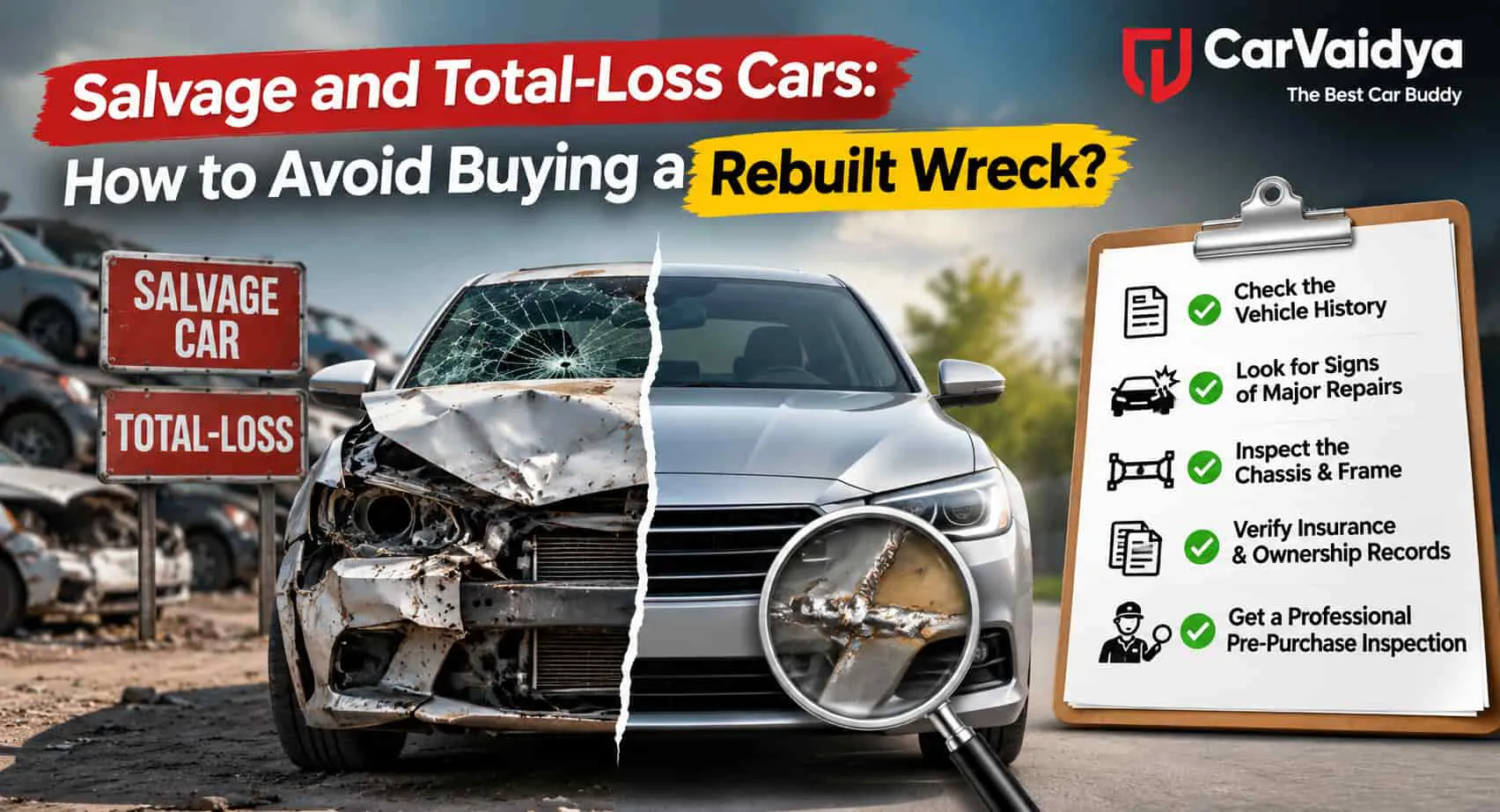
 By CarVaidya
- 19 Nov 2026
Every year, many cars in India are badly damaged in accidents, floods or fires. When the repair cost is too high, the insurer may declare the car a total loss, settle the claim and take the damaged vehicle as salvage. Some of these cars are later sold, rebuilt and quietly put back on the used car market — sometimes looking almost as good as new.
A properly repaired car isn't automatically dangerous. But a rebuilt wreck sold as a clean, accident-free car is a serious risk. Structural damage, poorly repaired safety systems, and hidden flood or fire damage can affect both safety and value. This guide explains what salvage and total-loss cars are, and how to spot one before you buy.
Quick Answer
A total-loss car is one the insurer decided was not worth repairing after major damage. A salvage car is the damaged vehicle sold off afterwards, often through auctions, and some are rebuilt and resold. To avoid buying one unknowingly, check past insurance policies and claim history, look for gaps in insurance or ownership, inspect for structural repairs, welding, repainted panels and uneven gaps, check airbag and safety warning lights, look for flood or fire damage, verify that chassis and engine numbers match the RC and aren't tampered with, and be wary of a price that's far below market. A professional used car inspection is the most reliable way to confirm the car's condition.
What Is a Total-Loss Car?
When a car is damaged, the insurer compares the estimated repair cost with the car's insured value (IDV). If repairs would cost too much compared with that value, or the car is beyond economical repair, the insurer may treat it as a total loss. The owner is paid according to the policy terms, and the insurer usually takes over the damaged vehicle.
Common causes include:
- Major collisions with structural damage
- Flood submersion, especially when water entered the engine and cabin
- Fire damage
- Theft recovery cases where the car was badly damaged or stripped
What Is a Salvage Car?
After a total-loss settlement, the damaged car is called salvage. Insurers commonly sell salvage through auctions or salvage buyers. Some of these vehicles are broken up for parts. Others are repaired and resold.
India doesn't have a widely visible "salvage title" system like some other countries, so a rebuilt car's history isn't always obvious from the paperwork. That's why buyers need to check carefully.
Why Rebuilt Total-Loss Cars Are Risky
| Risk | Why it matters |
|---|---|
| Weakened structure | Poorly repaired pillars, chassis rails or crumple zones may not protect occupants as designed in a future crash |
| Safety systems | Airbags, seatbelt pretensioners, ABS or ADAS sensors may not have been properly replaced or calibrated |
| Hidden electrical issues | Flood and fire damage can cause wiring and sensor problems that appear months later |
| Alignment and tyre wear | A bent structure can cause pulling, uneven tyre wear and handling issues |
| Low resale value | Once the history is discovered, the car is worth much less |
| Insurance problems | Insurers may raise questions during inspection, renewal or a future claim |
How to Spot a Rebuilt Salvage or Total-Loss Car
1. Check the insurance and claim history
Ask the seller for insurance policies from previous years, not just the current one. Look at the No Claim Bonus (NCB): a sudden drop to zero points to a claim. Ask what the claim was for and how large it was. A long gap with no insurance at all can mean the car was off the road after serious damage. Learn more about how No Claim Bonus works.
2. Look at ownership and registration records
Check the RC and the VAHAN record. Be cautious if you see an unusual ownership chain, a recent ownership change shortly before the sale, a duplicate RC without a clear reason, or details that don't match the car. Read how to verify RC details before buying a used car and how to check whether an RC is original.
3. Match the chassis and engine numbers
The chassis (VIN) and engine numbers on the car must match the RC exactly. Look closely at the chassis stamp. Signs of grinding, re-stamping, fresh paint, or welding around it are serious red flags. Also check that the VIN plate is properly fixed and hasn't been removed or replaced.
4. Inspect the structure, not just the panels
Bolt-on panels like doors and bumpers are often replaced after minor accidents. Total-loss repairs usually go deeper. Check for:
- Welding marks, new seam sealer, or uneven joints on pillars, aprons, and chassis rails
- Wrinkles, cuts or patch panels in the boot floor or under the carpets
- Fresh underbody paint or coating in patches
- Radiator support or front frame that looks newer than the rest of the car
See 7 signs of previous collision damage and how to tell if a bonnet has been in an accident.
5. Check paint, panel gaps and repainting
Major repairs almost always involve repainting. Look for colour differences between panels, overspray on rubber seals and trims, and uneven panel gaps. A paint thickness gauge shows which panels have been repainted. Read 5 ways to tell if a car has been repainted and how a paint thickness meter works.
6. Check airbags and safety systems
Serious accidents often deploy airbags. When you start the car, the airbag (SRS) warning light should come on briefly and then switch off. A light that stays on, never comes on at all, or mismatched airbag covers on the steering wheel or dashboard are warning signs. Also check that seatbelts retract properly and look for a different label date on belts or airbag modules.
7. Look for flood and fire damage
Flood-damaged cars may show silt under carpets and seats, rust in unusual places, corroded connectors, water lines, and a musty smell. Fire-damaged cars may show melted plastics, discoloured wiring, new wiring harnesses or smoke odour. Read how to spot and avoid a flood-damaged used car and what gets damaged when a car is stuck in floodwater.
8. Compare component dates
Windscreen and window glass, seatbelts, tyres and some parts carry date or brand markings. If several of them are much newer than the car, or don't match each other, ask what was replaced and why.
9. Pay attention on the test drive
A car with a damaged or poorly repaired structure may pull to one side, have a crooked steering wheel when driving straight, make knocking noises over bumps, or show uneven tyre wear. Check whether the steering has been repaired and whether the engine has been repaired.
10. Be suspicious of a price that's too good
Rebuilt cars are cheaper to buy as salvage, so sellers can price them below similar cars and still make a profit. If a car is priced well below the market without a clear reason, find out why before getting excited. Read how to get the best deal on a used car.
Red Flags at a Glance
- Seller can't or won't show past insurance policies
- NCB dropped to zero with a vague explanation
- Long gap without insurance
- Duplicate RC or a recent, unexplained ownership change
- Chassis stamp looks ground, re-stamped or repainted
- Welding on pillars, aprons or chassis rails
- Airbag light stays on or doesn't light up at start-up
- Silt, rust, corrosion, or smoke smell inside the cabin
- Car pulls to one side, or tyres wear unevenly
- Price far below similar cars
Also see the top 10 red flags when buying a used car and the biggest lies used car sellers tell.
Accident-Repaired vs. Rebuilt Total-Loss: What's the Difference?
| Minor accident repair | Rebuilt total-loss car |
|---|---|
| Bumper, door, or panel repaired or replaced | Structural parts cut, welded, or replaced |
| Usually repaired under insurance or at a workshop | Written off by the insurer, then rebuilt by someone else |
| Safety systems typically unaffected | Airbags and safety systems may have been deployed or damaged |
| Modest effect on resale value | Large effect on resale value |
Not every car with an accident history should be avoided. What matters is how serious the damage was, how well it was repaired, and whether the seller is honest about it. Read how to check if a car has been in an accident.
Questions to Ask the Seller
- Has the car ever been in a major accident, flood, or fire?
- Has an insurance claim ever been made? For what, and how much?
- Were the airbags ever deployed?
- Can I see all insurance policies and service records?
- Where did you buy the car, and from whom?
- Can I get the car independently inspected before paying?
A seller who refuses an independent inspection is giving you an answer of its own.
Get a Professional Used Car Inspection
Rebuilt cars are often cleaned up to look perfect. A CarVaidya used car inspection checks the structure, paint thickness, panel gaps, underbody, airbags and safety systems, electricals and documents, and runs a diagnostic scan, so you know whether the car has a serious past before you pay. Add a CarVaidya car service history report to review recorded service and repair entries.
Still unsure? Read why smart buyers get an inspection even when the dealer says the car is perfect.
Frequently Asked Questions
What is a total-loss car?
A total-loss car is one the insurer decided was not worth repairing after major damage, usually because the repair cost was too high compared with the car's insured value. The insurer settles the claim and typically takes the damaged car.
Can a total-loss car be sold again in India?
Yes. Insurers often sell damaged vehicles as salvage, and some are repaired and resold. The concern for buyers is a rebuilt car being sold without disclosing its history.
How can I find out if a used car was declared a total loss?
Ask for all past insurance policies and claim details, check the RC and ownership history, and get a professional inspection to look for structural repairs, airbag deployment, and flood or fire damage.
Is a rebuilt car safe to drive?
It depends on the damage and the quality of the repair. A poorly rebuilt structure or improperly replaced safety systems can reduce crash protection. Have the car thoroughly inspected before deciding.
How do I know if a car's airbags have been deployed?
Watch the airbag warning light at start-up: it should come on briefly and then go off. Also look for mismatched airbag covers, newer-looking steering wheel or dashboard parts, and seatbelts that don't retract properly. A diagnostic scan can reveal stored airbag fault codes.
Should I ever buy a rebuilt total-loss car?
Only if the seller is fully honest about its history, the repair quality is confirmed by a professional inspection, the paperwork is clean, and the price reflects its past. For most buyers, a car with a clean history is the safer choice.
Final Thoughts
A rebuilt wreck can look perfect on the outside. The real story is in the insurance history, the structure underneath, the safety systems and the details most buyers never check. Take your time, ask direct questions, and get the car professionally inspected. If something doesn't add up, walk away — there's always another car.

0 Comments