


Documents Required to Sell a Car in India
 By CarVaidya
- 26 Nov 2026
Finding a buyer is only half the job when you sell your car. The other half is paperwork. Missing documents can delay the sale, lower the price, or worse — leave the car registered in your name after it's gone. If the new owner gets a challan or is involved in an accident before the RC is transferred, you could still be the one answering questions.
This guide lists every document you need to sell a car in India, explains what each one is for, and walks you through completing the ownership transfer safely.
Quick Answer
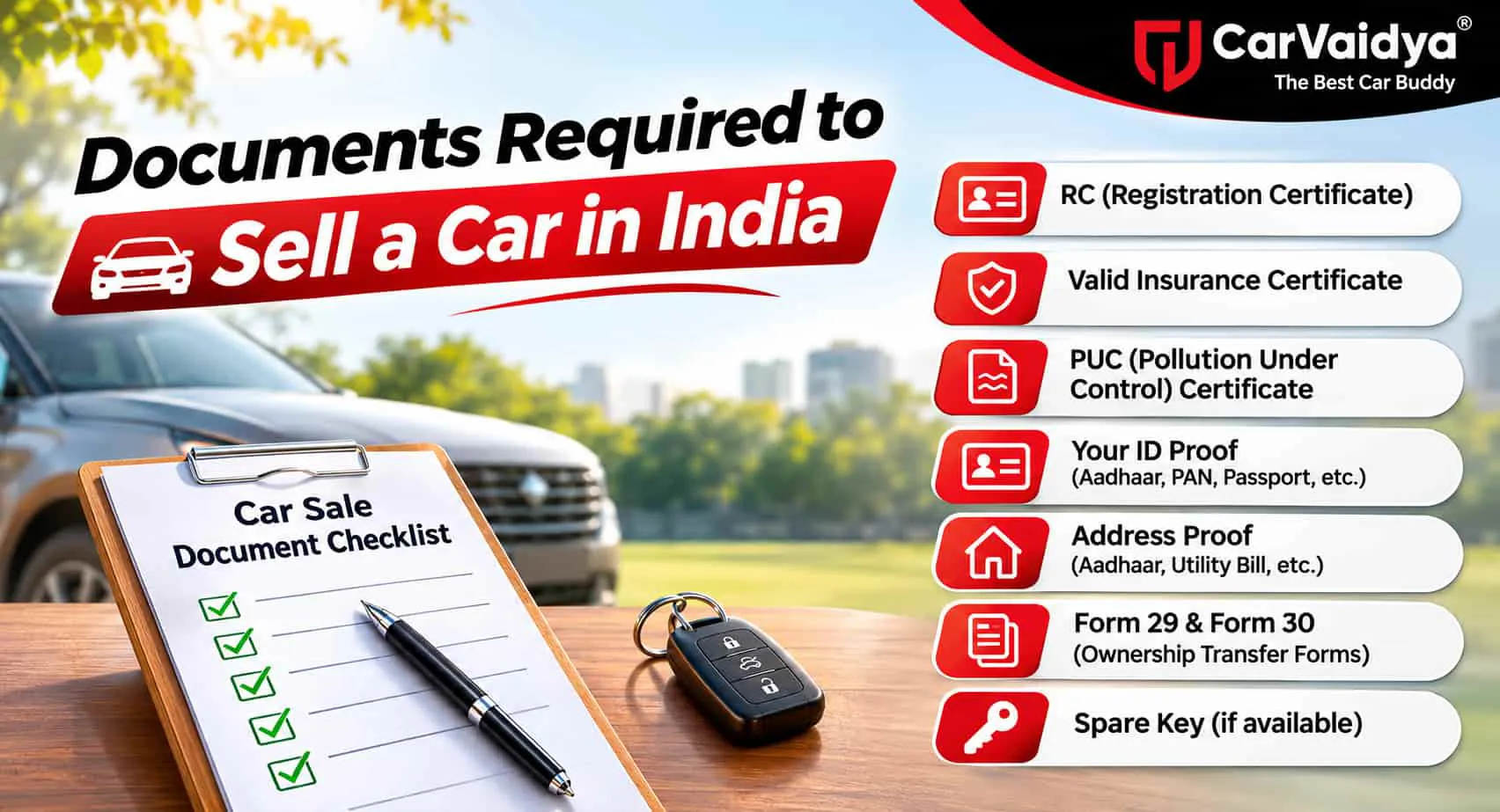
To sell a car in India, you need the original RC, Form 29 (notice of transfer of ownership), Form 30 (application for transfer), a valid insurance policy, a valid PUC certificate, ID and address proof, and a signed sale receipt or delivery note. If the car was on loan, add the bank NOC and Form 35. If the buyer is in another state, you'll also need an NOC in Form 28. Clear all pending challans first, hand over the service records, owner's manual, and both keys, and make sure the RC and insurance are transferred to the buyer's name.
Complete Checklist of Documents to Sell a Car
| Document | Why it's needed | When required |
|---|---|---|
| Original Registration Certificate (RC) | Proves ownership; needed for transfer | Always |
| Form 29 | Notice of transfer of ownership, signed by seller and buyer | Always |
| Form 30 | Application for transfer of ownership | Always |
| Valid insurance policy | Must be transferred to the buyer | Always |
| Valid PUC certificate | Required for RTO transfer | Always |
| Seller's ID and address proof | Verifies the seller's identity | Always |
| PAN card copy (or Form 60/61) | Identity and tax records | Generally required |
| Sale receipt / delivery note | Records date, time, price and handover | Always (strongly recommended) |
| Bank NOC + Form 35 | Removes the lender's name from the RC | If the car was bought on loan |
| NOC in Form 28 | Allows registration in another state | If the buyer is in another state |
| Service records, owner's manual, warranty papers | Builds trust and supports a better price | Recommended |
| Original purchase invoice | Proof of original purchase and price | Recommended |
| Both car keys | Missing keys reduce value and raise doubts | Always |
Key Documents Explained
1. Registration Certificate (RC)
The RC is the most important document in any car sale. It shows who owns the car, along with the chassis number, engine number and registration validity. Make sure the details on your RC match the VAHAN record. If there's a mismatch in your name, address or vehicle details, fix it before you sell. Read what your RC details mean.
If you've lost the RC, apply for a duplicate RC at your RTO before putting the car up for sale. Buyers are rightly cautious about cars sold without an original RC.
2. Form 29 – Notice of Transfer of Ownership
Form 29 informs the RTO that you are transferring the car to a new owner. It's signed by both the seller and the buyer. RTOs commonly ask for two copies.
3. Form 30 – Application for Transfer of Ownership
Form 30 is the actual application to record the buyer as the new owner. It's also signed by both parties and submitted to the RTO, usually by the buyer.
Both forms can be downloaded from the Parivahan website. In many states, the transfer can now be started online through the VAHAN portal, with Aadhaar-based authentication reducing RTO visits. See our guide to transferring RC ownership online.
4. Car Insurance Policy
The insurance must be valid at the time of sale and should be transferred to the buyer's name. Until it's transferred, a claim made by the new owner may run into problems.
Tip for sellers: Your No Claim Bonus (NCB) belongs to you, not the car. Ask your insurer for an NCB retention certificate so you can use your discount on your next car. Learn more about how No Claim Bonus works.
5. PUC Certificate
A valid Pollution Under Control certificate is needed for the RTO to process the transfer. If yours has expired or is close to expiry, renew it before the sale — it only takes a few minutes at an authorised PUC centre.
6. Bank NOC and Form 35 (If the Car Had a Loan)
If you bought the car on loan, the lender's name appears on the RC as hypothecation. The car can't be cleanly transferred until it's removed. After closing the loan, collect the bank NOC and a signed Form 35, and apply for hypothecation removal. Here's how to check and remove hypothecation from your RC.
If the loan isn't fully paid yet, you'll need to close it before or as part of the sale, often with the buyer's payment going towards settling the loan.
7. NOC in Form 28 (For a Buyer in Another State)
If the buyer will register the car in a different state, you'll need an NOC from your RTO in Form 28. It confirms there are no dues or objections against the car. Read how to get a car NOC for another state.
8. Sale Receipt or Delivery Note
This is one of the most important documents for the seller's protection. It should clearly mention:
- Names, addresses and ID details of the seller and buyer
- Registration, chassis and engine numbers
- Sale price and payment mode
- Date and exact time of handover
- Odometer reading at handover
- A line stating that the buyer is responsible for the car from that moment onwards
- Signatures of both parties, ideally with a witness
Keep a signed copy with you. If the car is involved in a challan or accident after the handover, this document helps show it was no longer in your possession.
Things to Do Before You Sell
- Clear pending challans. Unpaid challans can block the RC transfer. Check the e-Challan portal and your city traffic police portal. Read why checking challans matters before selling.
- Check your RC details on VAHAN. Make sure the owner name, address and vehicle details are correct.
- Remove hypothecation if the car loan is closed.
- Renew insurance and PUC if they're about to expire.
- Gather service records. A complete service history helps you get a better price. See how service history affects resale value.
- Find both keys. A missing spare key can reduce the price.
How to Complete the Sale Safely: Step by Step
- Verify the buyer. Collect a copy of the buyer's ID and address proof.
- Receive full payment first. Prefer bank transfer or a demand draft, and confirm the amount has reached your account before handing over the car.
- Sign Form 29 and Form 30 along with the buyer.
- Sign the sale receipt and delivery note with the date, time and odometer reading.
- Hand over documents and keys. Give the RC, insurance, PUC, NOCs (if any), service records and both keys.
- Submit the transfer. Make sure the transfer application is filed at the RTO or on VAHAN promptly. Don't leave it entirely to the buyer — follow up.
- Transfer the insurance. Ensure the policy is moved to the buyer's name, and collect your NCB retention certificate.
- Confirm the transfer. Check the VAHAN record after a few weeks to confirm the car is no longer in your name.
Why this matters: Until the RC is transferred, the car is still legally registered to you. Traffic challans, parking violations and even accident-related issues may come to your address. Don't consider the sale complete until the transfer shows on VAHAN.
After the Sale: Don't Forget These
- FASTag: Close or transfer the FASTag linked to the car, so toll charges aren't deducted from your account.
- Connected car apps: Remove the car from your brand's connected car app and log out of any accounts.
- Infotainment data: Delete paired phones, saved addresses and contacts from the infotainment system.
- Personal items: Check the glovebox, boot and seat pockets for documents and belongings.
- Keep copies: Store copies of Forms 29 and 30, the sale receipt and the buyer's ID safely.
Selling to a Dealer vs. an Individual
| Aspect | Dealer or online platform | Individual buyer |
|---|---|---|
| Paperwork | Often handled by the buyer's team | You and the buyer handle it |
| Price | Usually lower | Usually higher |
| Transfer follow-up | Still confirm the RC transfer yourself | Needs close follow-up |
Whichever route you take, always keep signed copies of all forms and a dated delivery note, and confirm the transfer on VAHAN.
Make Selling Your Car Easier With CarVaidya
From clearing pending challans and removing hypothecation to RC transfer and NOC paperwork, CarVaidya's RTO services can help you complete the formalities smoothly. A CarVaidya car inspection report can also help you show buyers the car's real condition and support a fair price.
Related reads: factors that affect a used car's resale value, documents required for different RTO services, and the car documents checklist for 2026.
Frequently Asked Questions
What documents are needed to sell a car in India?
You need the original RC, Form 29, Form 30, valid insurance, a valid PUC certificate, ID and address proof, and a signed sale receipt. Add the bank NOC and Form 35 if the car had a loan, and an NOC in Form 28 if the buyer is in another state.
What is the difference between Form 29 and Form 30?
Form 29 is the notice informing the RTO that ownership is being transferred. Form 30 is the application to record the buyer as the new owner. Both are signed by the seller and the buyer.
Can I sell a car that is still on loan?
Yes, but the loan must be closed and hypothecation removed before the RC can be transferred cleanly. You'll need the bank NOC and Form 35. Often, the buyer's payment is used to settle the remaining loan.
Who is responsible for the RC transfer — the buyer or the seller?
Both have a role. The seller signs the transfer forms and hands over documents; the buyer usually submits the application. Sellers should follow up and confirm on VAHAN that the transfer is complete, since the car stays in their name until then.
Can I transfer my No Claim Bonus to my new car?
Yes. NCB belongs to the policyholder, not the car. Ask your insurer for an NCB retention certificate when you sell, and use it when buying insurance for your next car.
Can I sell a car without the original RC?
It's best not to. If the RC is lost, apply for a duplicate RC at your RTO before selling. Buyers and the RTO will need valid proof of ownership to complete the transfer.
Do I need to clear challans before selling my car?
Yes. Pending challans can block the RC transfer and lead to disputes with the buyer. Check and clear them on the e-Challan portal before the sale.
Final Thoughts
Selling a car smoothly comes down to having the right documents ready and following through on the transfer. Keep your RC, Forms 29 and 30, insurance and PUC in order, clear challans and any loan, and always get a signed, dated delivery note. Most importantly, don't consider the sale complete until the RC shows the new owner's name on VAHAN.

0 Comments